-
Korean Equities/Company Deep Dives
A Statistical Mirage Nearly Convinced Markets Korea's Chip Boom Was Cracking
2026. 8. 10.
Table
반응형On July 1, 2026, Korea's export data showed something that should have been unambiguously bullish: exports crossed $100 billion in a single month for the first time ever, with semiconductor exports breaking $40 billion for the first time. Instead, the market fixated on a single declining sub-metric, compounded it with worries from Apple and Meta, and spent the following week debating whether Korea's memory boom was starting to crack. Six days later, Samsung Electronics answered the question directly. This is the story of how a statistical illusion nearly convinced a market otherwise.
Table of Contents
- A Record Month, and the Number That Spooked the Market
- Apple, Meta, and a Growing Wall of Worry
- Meta's AI Agent Setback Adds Fuel
- The Statistical Mirage in "Price Per Kilogram"
- The Ministry's Own Data Told a Different Story
- July 7: Samsung's Earnings Answer the Question
- Why This Quarter Traces Back to a 2023 Bet
- Why Earnings and Stock Price Don't Always Move Together
- Bottom Line
A Record Month, and the Number That Spooked the Market
Korea's Ministry of Trade, Industry and Energy releases export data on the first day of each month — making it, by a wide margin, the earliest major trade release of any large economy, and a genuine leading indicator that foreign investors track closely. The July 1, 2026 release for June was, on its face, historic: total exports hit $102.2 billion, the first time Korea has ever crossed $100 billion in monthly exports, while semiconductor exports reached $44.8 billion, also a first-time milestone above $40 billion.
The scale of Korea's chip dependence has grown dramatically. Semiconductors made up roughly 13% of Korean exports as recently as January 2023; that share crossed 40% for the first time in May 2026 and climbed further to 44% in June. Because of this concentration, Korea's monthly export data has effectively become a real-time proxy for global memory chip pricing — which is exactly why a single softening metric buried in an otherwise record-breaking release triggered outsized concern.
That metric was the export unit price for DRAM: $74,687 per kilogram in June, down 4% from May, with SSD unit prices also falling 5%. The DRAM unit price index, widely watched as a proxy for commodity DRAM pricing, declined month-over-month for the first time in nine months — and this single data point became the market's dominant talking point, overshadowing the record headline figures entirely.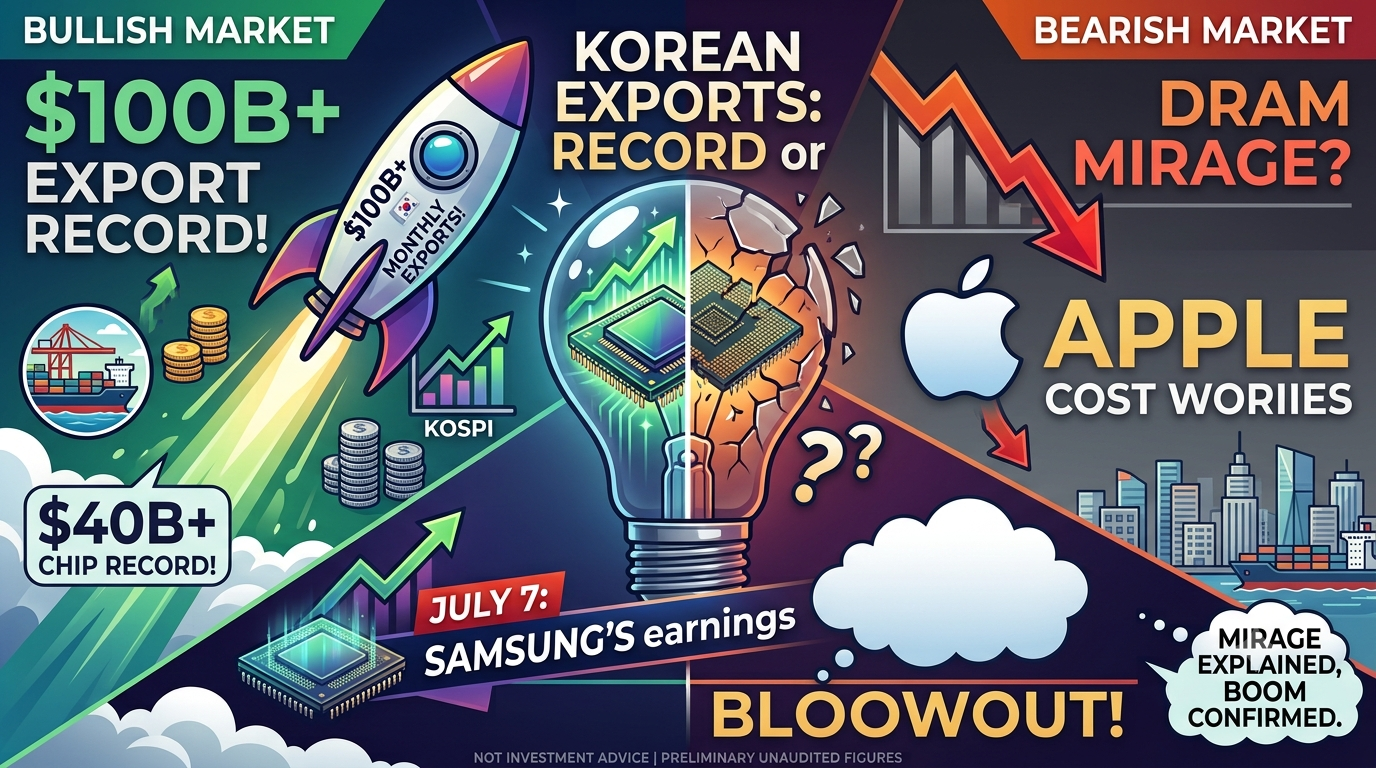
How One Misread Export Metric Triggered a Week of Semiconductor Panic 반응형Apple, Meta, and a Growing Wall of Worry
The timing compounded the concern. Around the same period, Apple raised product prices by 15-20% and specifically cited rising memory costs as a driver — prompting a natural inference among investors: "if even Apple is raising prices because of memory costs, how much worse must it be for smaller players?" The fear was straightforward: if chip cost inflation gets passed through to end-product prices, higher prices could suppress demand, which could in turn soften the memory demand driving the entire sector's earnings story.
Meta added another layer. On July 1, Bloomberg reported that Meta was exploring entering the cloud computing business to monetize surplus AI compute capacity — interpreted by markets as a signal that Meta's own AI infrastructure buildout might be running ahead of actual internal demand. Meta's own stock rose on the news, but the Philadelphia Semiconductor Index fell more than 6%, as investors read the story as a potential early warning sign for AI infrastructure spending more broadly.Meta's AI Agent Setback Adds Fuel
A second Meta-related report followed almost immediately. Reuters reported details from an internal Meta town hall in which CEO Mark Zuckerberg told employees that "AI agent development hasn't accelerated the way we expected over the past four months." Roughly a year earlier, Meta had recruited Alexandr Wang — the founder of data-labeling company Scale AI, acquired via a $14.3 billion investment for a 49% stake that included Wang's move to Meta as Chief AI Officer — specifically to lead this effort. A first model under Wang's leadership, released in April 2026, was reportedly viewed internally as a disappointment. The optics were unflattering: a major AI lab had paid a premium to recruit a widely regarded prodigy, and a year later was publicly acknowledging the results hadn't materialized — a narrative that reinforced, rather than contradicted, the prior day's cloud-pivot report about surplus AI compute.
The Statistical Mirage in "Price Per Kilogram"
Here is where the market's reaction ran into a measurement problem. Korea's export unit price is calculated simply as total value divided by total weight — a metric that is extremely sensitive to product mix, not just underlying price trends. Consider April 2026: semiconductor export volume by weight fell 12% year-over-year, while export value rose 173% — because the shipment mix shifted from something like ten DDR4 units (2.5 grams total) selling for $15, toward a combination of one HBM3E unit (1.5 grams) and three DDR5 units (0.6 grams) totaling 2.1 grams but selling for $300. A relatively small shift in the proportion of HBM versus standard DRAM shipped in a given month can swing the calculated "price per kilogram" figure significantly, independent of what actual per-unit selling prices are doing.
The Ministry's Own Data Told a Different Story
Korea's trade ministry directly addressed this in its June briefing, confirming that DDR5 (16Gb) fixed transaction prices had been rising consistently — $35 in April, $37.50 in May, $40 in June. In other words, actual DRAM pricing was climbing throughout the same period the "price per kilogram" export metric appeared to be falling — the headline decline was a product-mix artifact, not evidence of underlying price weakness.
July 7: Samsung's Earnings Answer the Question
The debate over which interpretation was correct didn't stay theoretical for long. On July 7, 2026, Samsung Electronics reported second-quarter operating profit of 89.4 trillion Won — up 56.21% from 57.23 trillion Won in the first quarter, and roughly 5-6 trillion Won ahead of analyst consensus. Compared to 4.68 trillion Won in the same quarter a year earlier, this represented a 1,810% year-over-year increase, on revenue of 171 trillion Won, up 129.31% year-over-year.
Revenue 171.00T KRW 133.87T KRW +27.74% 74.57T KRW +129.31% Operating Profit 89.40T KRW 57.23T KRW +56.21% 4.68T KRW +1,810.26% Notably, this quarter's operating profit includes an estimated 15 trillion Won in employee performance bonus payouts recognized across Q1 and Q2 combined (estimates ranged from 19 trillion Won at Nomura to 10 trillion Won at Kiwoom) — meaning underlying operating profit, excluding bonuses, would have come in closer to 100 trillion Won. These are preliminary, unaudited figures under K-IFRS consolidated accounting, subject to revision at board approval.
The blowout result effectively settled the debate that had consumed the market for the prior week: the "unit price mirage" explanation was correct, and the June DRAM export price decline reflected shifting product mix rather than genuine pricing weakness. As one market observer noted heading into the print, a result meaningfully above consensus would validate the mirage theory, while an in-line or disappointing result would validate the bears — and the result landed decisively in the former camp.Why This Quarter Traces Back to a 2023 Bet
Context makes the scale of this quarter's results more striking. In the first half of 2023, Samsung Electronics posted a 7.6 trillion Won loss, ending the year with a full annual loss of 14 trillion Won. Despite that, 2023 was also the year Samsung made its largest-ever facility investment, spending 48 trillion Won — most of it directed toward upgrading the P1-P3 fabs and building out infrastructure at P4. Those same P1-P3 facilities are now responsible for more than half of Samsung's DRAM revenue, currently one of the company's strongest profit drivers. In effect, capital committed during a loss-making year is what enabled Samsung to capture this quarter's memory upcycle at scale.
Why Earnings and Stock Price Don't Always Move Together
The week between the export data and the earnings release is also a useful reminder that short-term stock prices trade on expectations and narrative as much as on realized fundamentals. A single ambiguous data point, reinforced by unrelated headlines from Apple and Meta, was enough to shift market sentiment meaningfully for several trading days — despite the underlying pricing data, properly interpreted, pointing the opposite direction the entire time. Over longer horizons, stock prices tend to converge more closely with underlying earnings performance, which is part of why the multi-year investment cycle matters more for long-term valuation than any single week's headline-driven narrative.
Bottom Line
A single statistical artifact in Korea's June export data — a falling "price per kilogram" figure driven by shifting DRAM-to-HBM product mix rather than actual pricing weakness — combined with unrelated AI-spending concerns from Apple and Meta to briefly convince markets that Korea's memory upcycle was cracking. Korea's own trade ministry data showing rising DDR5 fixed prices throughout the same period suggested otherwise, and Samsung Electronics' record-beating Q2 earnings on July 7 resolved the debate decisively — a result made possible in part by capital investment decisions made during Samsung's loss-making 2023.
This article is for informational purposes only and does not constitute investment, tax, or legal advice. Samsung's Q2 2026 figures are preliminary and unaudited, and may differ from final confirmed results. Readers should consult a licensed professional before making investment decisions.
반응형'Korean Equities > Company Deep Dives' 카테고리의 다른 글
Korean Stock & Equity Research
Data-driven analysis of Korean listed companies, combining financial fundamentals with supply chain and operations insights. Not investment advice.