-
Macro & Policy/Currency & Rates
Why US Treasury Yields Keep Rising Despite Everything Bessent Has Tried
2026. 8. 18.
Table
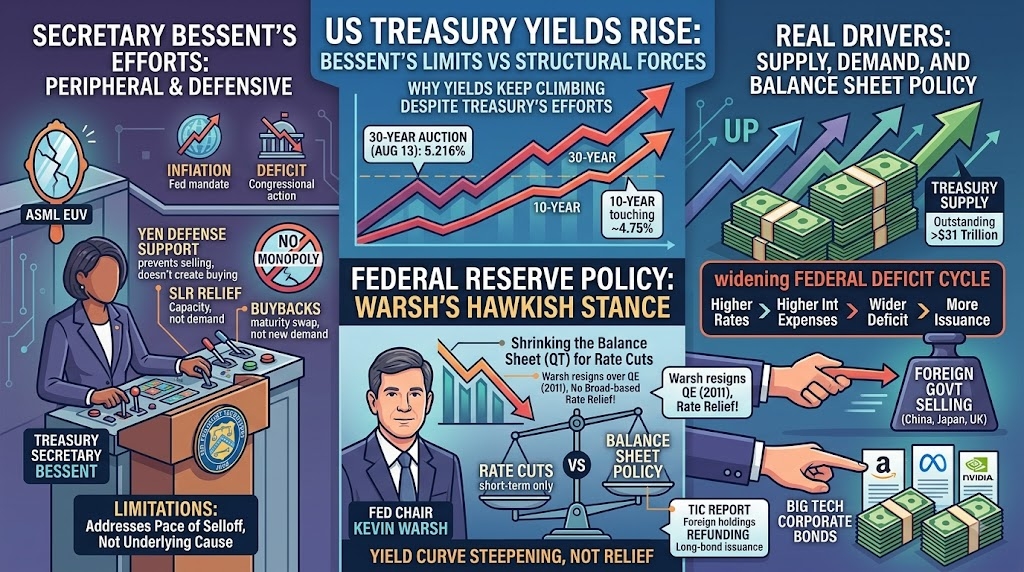
반응형The US 30-year Treasury yield hit 5.216% at auction on August 13, 2026 — the highest borrowing cost in a quarter century — even as Treasury Secretary Scott Bessent has deployed nearly every tool available to him. The reason yields keep climbing despite his efforts is structural: the actual levers that move long-term rates sit with the Federal Reserve and Congress, not the Treasury Department, and Fed Chair Kevin Warsh has made clear he won't pull the one lever that would work fastest.
Where Do Treasury Yields Stand Right Now?
As of mid-August 2026, the 10-year Treasury yield has traded above 4.6% for nearly a month, touching a 19-month high near 4.75%, while the 30-year yield has held above 5% for its longest stretch since 2007 — more than 27 consecutive days on one tracker. The August 13 30-year auction cleared at 5.216%, the highest level since 2001; the preceding 10-year auction drew the highest financing cost for that tenor since 2007. Wall Street had pegged psychological resistance levels around 4.5% for the 10-year and 5% for the 30-year — both have been decisively broken.
 반응형
반응형What Has Bessent Already Tried?
Tool What It Does Limitation Yen intervention support Backed Japan's efforts to defend the yen, discouraging Japan from dumping US Treasuries to fund it Defensive only — prevents selling, doesn't create new buying SLR regulatory relief (April 2026) Eased capital requirements so 8 major banks can hold more Treasuries without a capital penalty Gives banks capacity, doesn't force them to buy Treasury buybacks Repurchases illiquid old long bonds, funded by new short-term issuance, $38B quarterly cap A maturity swap, not new demand Each of these tools works around the edges of the problem. None of them address the two forces actually pushing long-term yields higher.
Why Is the Treasury Secretary's Power Limited?
Bessent has repeatedly said the 10-year yield matters more to him than the stock market or the Fed funds rate, calling himself "the nation's top bond salesman." But the Treasury Secretary's toolkit only manages the pace of a selloff, not the underlying cause. The two structural drivers — persistent inflation and a widening federal deficit — sit outside Treasury's authority entirely: inflation is the Fed's mandate, and deficit reduction requires congressional action neither party has meaningfully delivered.
What's Really Driving Yields: Supply and Demand
The US Treasury market has grown roughly sevenfold since 2007, from $4.5 trillion to over $31 trillion outstanding. The federal deficit is projected at roughly $1.9 trillion for 2026 and an average of $2.4 trillion annually from 2027 through 2036, with interest expense alone exceeding $1.2 trillion a year. This creates a self-reinforcing cycle: higher rates raise interest costs, higher costs widen the deficit, a wider deficit requires more issuance, and more issuance pushes rates higher still. Nuveen's head of fixed income, Rodriguez, has attributed sustained upward pressure on long-term rates directly to this dynamic.
✅ What to Watch Next: A Checklist
- Whether the 10-year yield holds above 4.5% or the 30-year holds above 5%
- Foreign central bank Treasury holdings data (TIC report) for continued Chinese, Japanese, and UK selling
- Monthly corporate bond issuance volume from AI-linked hyperscalers competing for the same capital
- Any language change in Treasury's quarterly refunding announcements on long-bond issuance
- Clarity Act legislative progress in September 2026
- Whether Fed Chair Warsh shows flexibility on balance sheet policy under political pressure
Are Foreign Governments Selling US Treasuries?
Yes. Month-over-month data shows China's Treasury holdings fell from $659.0 billion in May 2026 to $633.0 billion in June, with China redirecting capital toward gold. Japan's holdings fell a similar $26 billion over the same period, from $1.143 trillion to $1.117 trillion, while the UK — which had partially absorbed China's selling — also saw a $9 billion decline. Combined, the three largest foreign holders reduced Treasury positions by roughly $61 billion in a single month.
How Is Big Tech's Borrowing Boom Competing With Treasuries?
Global corporate bond issuance hit a record $3.68 trillion in the first half of 2026, led by Amazon at $54 billion, with Meta, Nvidia, Oracle, and SpaceX each issuing roughly $25 billion, and August alone saw US investment-grade issuers sell a record $145.2 billion in corporate debt. When pension funds and insurers can earn better yields on Big Tech corporate bonds, they allocate less to Treasuries, forcing the Treasury to offer higher yields to stay competitive. Meta reportedly moved its offered spread over Treasuries from 1.2 to 1.4 percentage points just to secure sufficient investor interest.
Why Won't the Fed Just Do QE?
Quantitative easing is the one tool that could meaningfully lower long-term yields quickly — the Fed buying long bonds directly removes supply investors would otherwise need to absorb, while injecting liquidity. But QE requires the Fed's willingness, and that's where the current setup runs into a wall.
The Kevin Warsh Problem: QT for Rate Cuts
Kevin Warsh, confirmed as Fed Chair on May 13, 2026 in the most divisive confirmation vote in Fed history, has a long, documented aversion to quantitative easing — he resigned from the Fed's Board of Governors in 2011 specifically over disagreement with QE, and has since called it a policy that primarily "benefits markets" at everyone else's expense. His "QT for rate cuts" framework would lower the short-term policy rate while continuing to shrink the balance sheet — a combination that releases previously Fed-held long bonds back into the market, producing yield curve steepening rather than the broad-based rate relief the White House wants.
⚠️ Even a Rate Cut May Not Help
Even if Trump gets the rate cuts he's publicly pushed for, the 10-year and 30-year yields that actually matter for mortgages and corporate borrowing costs may not move — or could rise further — under Warsh's current framework.
Is the Clarity Act a Wildcard?
Pending stablecoin legislation known as the Clarity Act, expected to be reconsidered in September 2026, could accelerate stablecoin market growth from roughly $305 billion in market cap toward a Fed-projected $1-3 trillion by 2030. Because stablecoin issuers generally back tokens with short-term Treasury holdings, faster growth would increase demand specifically for T-bills, potentially letting the Treasury shift its issuance mix away from long-dated bonds — indirectly easing pressure on the long end of the curve.
Why This Matters for Korean Markets
As covered in our earlier piece on the US-Korea interest rate differential, rising US real yields work against continued Korean Won appreciation, all else equal, by making Dollar-denominated assets relatively more attractive. Persistently elevated US long-term rates also raise the bar for Korean corporate and sovereign borrowers issuing Dollar-denominated debt internationally, and add to the broader case for continued Bank of Korea policy tightening if the Won faces renewed depreciation pressure from this channel.
Frequently Asked Questions
Q1. Why can't the Treasury Secretary just lower interest rates?
A. The Treasury Secretary doesn't set interest rates — that authority sits with the Federal Reserve for short-term rates, while long-term rates are set by market demand for Treasury bonds, which Treasury can only influence indirectly through issuance mix and regulatory changes affecting bank demand.
Q2. Is oil the main reason Treasury yields are rising?
A. Oil price increases from Middle East tensions contribute meaningfully to inflation expectations, but the unusually large rise in real (inflation-adjusted) yields — reaching multi-decade highs — points to structural supply and demand factors as an equally significant driver.
Q3. Would a Fed rate cut lower mortgage rates?
A. Not necessarily. Fed rate cuts primarily affect short-term rates, while mortgage rates track more closely with the 10-year Treasury yield, which is influenced by balance sheet policy, deficit trajectory, and foreign demand — all currently working against a typical rate-cut effect.
반응형'Macro & Policy > Currency & Rates' 카테고리의 다른 글
Korean Stock & Equity Research
Data-driven analysis of Korean listed companies, combining financial fundamentals with supply chain and operations insights. Not investment advice.