-
Table
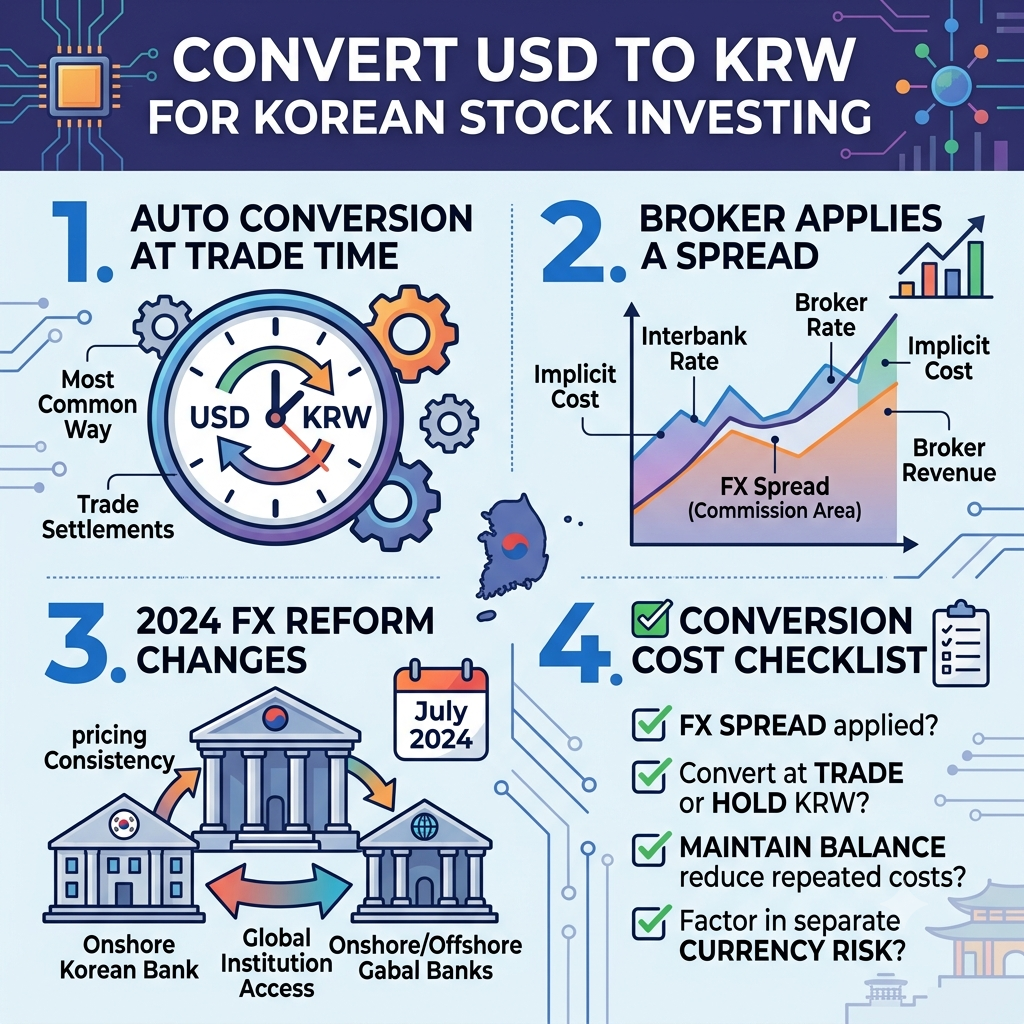
반응형Most foreign investors don't manually convert currency at all — their broker automatically converts USD to KRW at the time of trade execution, applying a spread over the interbank rate. Since a 2023 reform, Korea has also opened its onshore USD/KRW market directly to foreign financial institutions and extended local trading hours, changing how currency conversion happens at the institutional level. This article is part of our Ultimate Guide to Investing in South Korean Stocks for Foreigners.
Do I Need to Convert Currency Manually Before Buying Korean Stocks?
Generally no. Both international brokers and Korean brokerages typically handle USD-to-KRW conversion automatically as part of the trade settlement process, debiting your USD balance and executing the KRW-denominated purchase in a single flow. The conversion rate applied usually includes a spread over the prevailing interbank rate — this spread is where brokers often earn additional revenue beyond stated commissions, so it's worth comparing across brokers.
 반응형
반응형What Changed With Korea's 2023 FX Market Reform?
Korea's foreign exchange authority opened the onshore USD/KRW market to global financial institutions under a pilot program starting January 2024, and extended local trading hours until 2 AM starting July 2024 — a substantial expansion from the previous 9 AM to 3:30 PM window when the Won could only be traded directly against the Dollar through local banks. This reform was aimed partly at improving pricing consistency and reducing the historical gap between onshore and offshore (NDF) Won pricing that foreign investors previously had to navigate.
What Should I Watch for in Conversion Costs?
✅ Currency Conversion Cost Checklist
- Ask your broker for the exact FX spread applied on USD/KRW conversion, separate from trading commissions
- Compare whether your broker converts at trade time or lets you hold a KRW balance to convert opportunistically
- For frequent traders, check whether maintaining a standing KRW balance reduces repeated conversion costs
- Factor in currency risk separately from conversion cost — a favorable spread doesn't protect against adverse KRW moves during your holding period
Frequently Asked Questions
Q1. Does buying EWY avoid currency conversion entirely?
A. Yes, EWY trades and settles in USD, so buying it involves no direct KRW conversion — though the fund's underlying performance is still affected by USD/KRW movements.
Q2. Can I hold a KRW cash balance in my brokerage account?
A. Many international and Korean brokers allow holding a KRW balance between trades; confirm this specifically with your broker, as policies vary.
Q3. Did the 2024 FX reform lower conversion costs for retail investors?
A. The reform primarily targeted institutional-level market access and pricing consistency; retail-level cost impact depends on whether your specific broker passed through any resulting efficiency gains.
반응형'Macro & Policy > Currency & Rates' 카테고리의 다른 글
Korean Stock & Equity Research
Data-driven analysis of Korean listed companies, combining financial fundamentals with supply chain and operations insights. Not investment advice.