-
Korean Equities/Dividend & Value-up
How Chaebol Cross-Shareholding Structures Affect Dividend Policy
2026. 8. 30.
Table
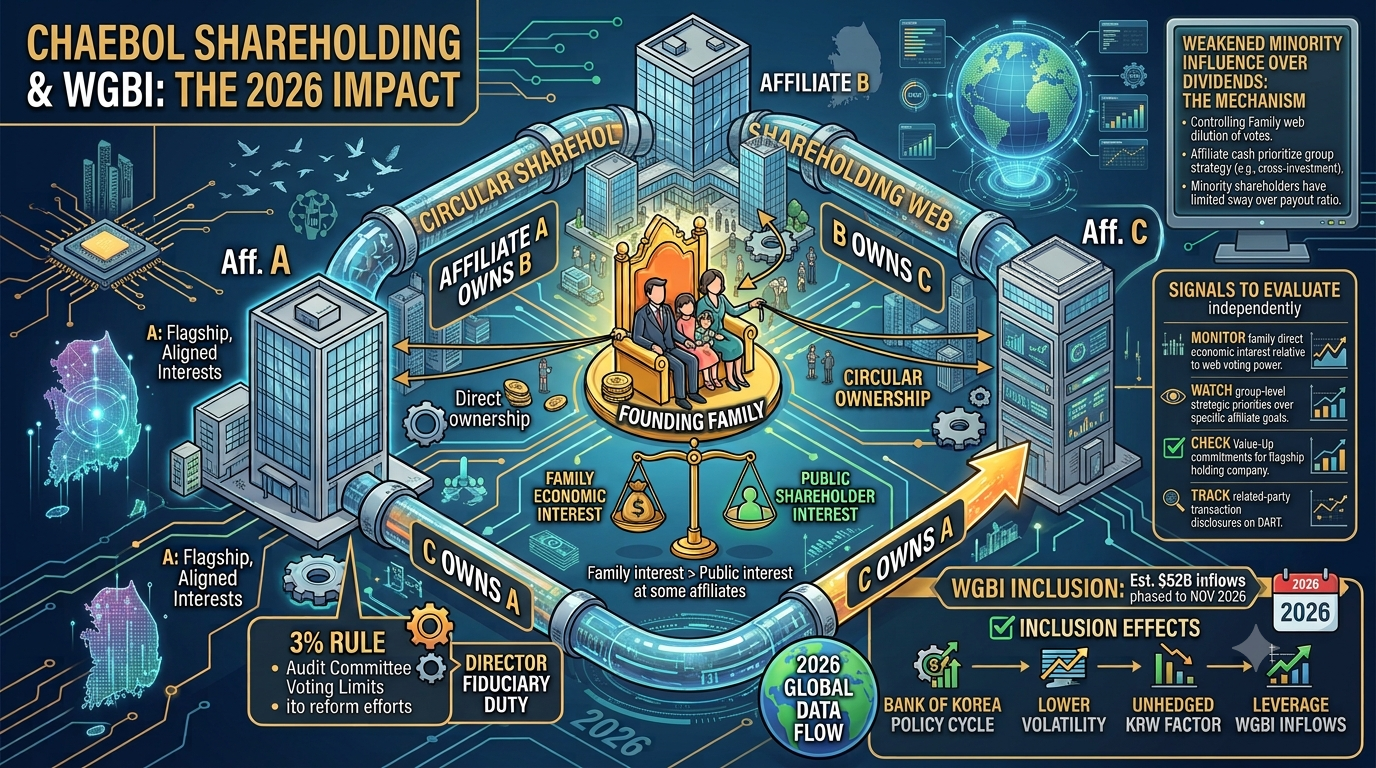
반응형Many Korean conglomerates historically used circular or cross-shareholding structures — where affiliate A owns shares in affiliate B, which owns shares in affiliate C, which owns shares back in affiliate A — allowing founding families to retain effective control with a relatively small direct ownership stake, a structure that has historically weakened the influence of ordinary minority shareholders over capital allocation and dividend decisions. This article is part of our Top High-Dividend Korean Stocks & Corporate Value-Up Strategy guide.
Why Does Ownership Structure Matter for Dividend Investors?
In a circular ownership structure, votes at any single affiliate's shareholder meeting can be effectively controlled by the founding family through its web of cross-holdings, even when that family's direct economic stake in the specific affiliate is small. This matters directly for dividend policy because capital allocation decisions — including how much to distribute to shareholders versus retain or redeploy within the group — can be shaped more by group-level strategic priorities than by what would maximize returns for that specific affiliate's outside shareholders.
How Do Reforms Covered Elsewhere in This Guide Address This?
✅ Reforms Targeting This Structure
- As covered in our Commercial Act reform guide, the expanded "3% rule" now limits a controlling shareholder's combined voting rights (with related parties) to 3% specifically in audit committee elections, directly targeting cross-holding-based control in this narrow context
- The expanded director fiduciary duty to shareholders (Article 382-3) applies regardless of ownership structure, in principle constraining decisions that favor the controlling family at minority shareholders' expense
- Legal commentators have noted, however, that mandatory disclosure of related-party transactions — arguably a more direct tool for addressing cross-shareholding abuse — remains outside the current reform package
 반응형
반응형What Should Investors Check Before Buying a Chaebol Affiliate?
Before treating a Value-Up dividend commitment from any group affiliate as fully reliable, it's worth understanding roughly where that specific company sits within its group's ownership web — a subsidiary several links removed from the founding family's direct economic interest may see dividend policy shaped differently than the group's flagship holding company, where family economic interest and public shareholder interest are more closely aligned.
Frequently Asked Questions
Q1. Are all large Korean companies structured with circular shareholding?
A. No, ownership structures vary significantly by group, and several major chaebols have restructured toward more conventional holding company models in recent years, partly in response to prior regulatory pressure.
Q2. Where can I find a company's ownership structure disclosed?
A. DART filings include shareholder composition disclosures; ownership structure charts are sometimes available through company IR materials or specialized Korean corporate governance research resources.
Q3. Does KVI membership account for ownership structure risk?
A. As covered in our KVI screening guide, the index's quantitative criteria (profitability, returns, valuation) don't explicitly screen for ownership structure risk, so this remains a separate factor investors should evaluate independently.
반응형'Korean Equities > Dividend & Value-up' 카테고리의 다른 글
The National Pension Service's Role in Korea's Value-Up Push (0) 2026.08.30 How to Check If a Korean Dividend Is Actually Sustainable (0) 2026.08.30 Korean High-Dividend ETFs: An Alternative to Stock-Picking (0) 2026.08.30 How Foreign Investors Can Screen for Korea Value-Up Index (KVI) Stocks (0) 2026.08.28 POSCO Holdings and Korea's Steel Sector Dividends Under Value-Up (0) 2026.08.27
Korean Stock & Equity Research
Data-driven analysis of Korean listed companies, combining financial fundamentals with supply chain and operations insights. Not investment advice.