-
Korean Equities/Dividend & Value-up
How to Check If a Korean Dividend Is Actually Sustainable
2026. 8. 30.
Table
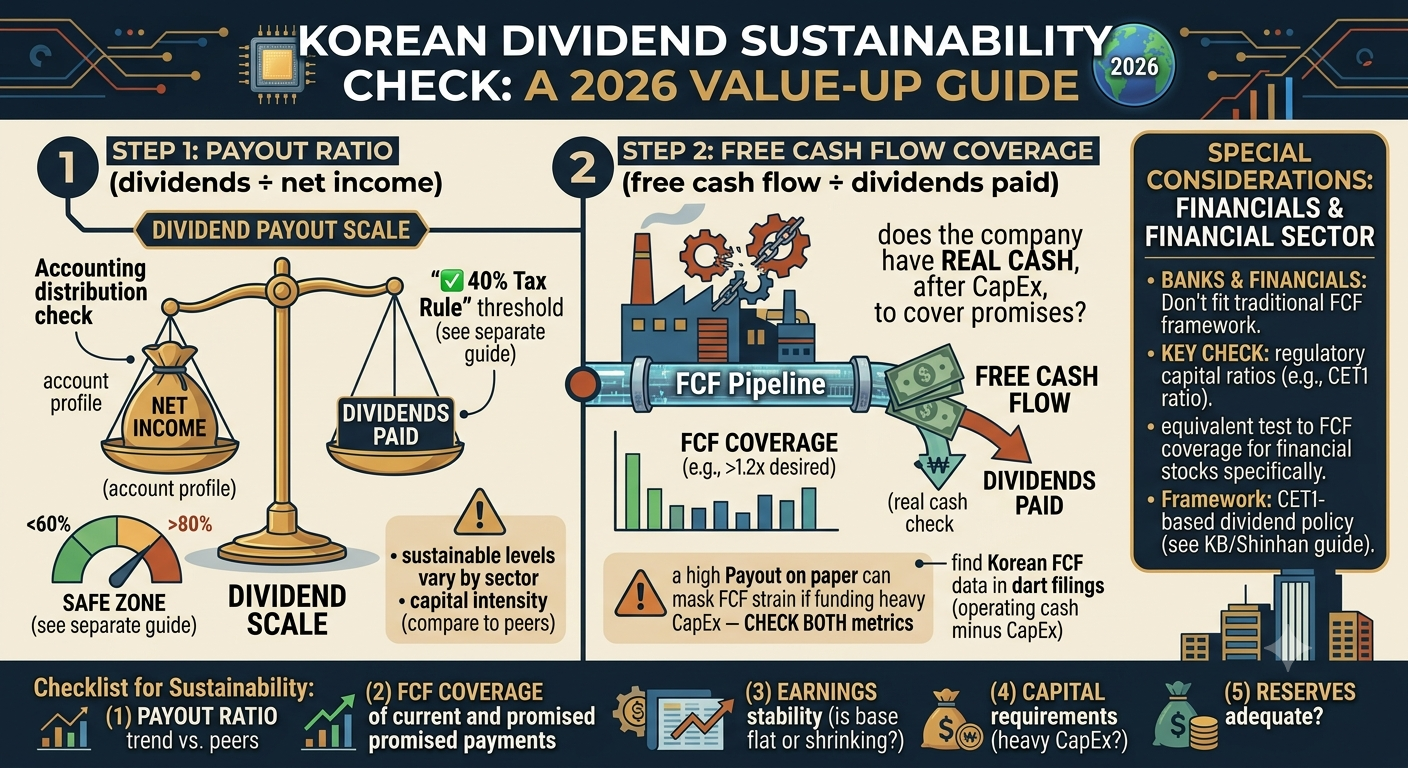
반응형A company's payout ratio (dividends paid as a share of net income) and its dividend coverage by free cash flow, not the headline dividend growth number, are the two figures that determine whether a Value-Up dividend commitment can actually hold up through a weaker earnings year. This article is part of our Top High-Dividend Korean Stocks & Corporate Value-Up Strategy guide.
Why Isn't Dividend Growth Alone a Good Signal?
A company can grow its per-share dividend year over year even while its payout ratio climbs to an unsustainable level, simply by distributing an increasing share of a flat or shrinking earnings base. As covered in our POSCO dividend piece, this risk is particularly relevant for cyclical sectors, where a high current yield can partly reflect a depressed earnings base rather than genuinely durable cash generation.
What's the Difference Between Payout Ratio and FCF Coverage?
✅ Two Metrics, Two Different Questions
- Payout ratio (dividends ÷ net income): asks "how much of accounting profit is being distributed?" — the metric directly tied to the 40% threshold in Korea's separate dividend taxation rule
- Free cash flow coverage (free cash flow ÷ dividends paid): asks "does the company actually generate enough real cash, after capital spending, to cover what it's promising shareholders?" — a stricter test, since net income can differ meaningfully from actual cash generation due to accounting items
- A company can show a comfortable payout ratio on paper while still straining on an FCF basis if it's simultaneously funding heavy capital expenditure — worth checking both, not just one
 반응형
반응형How Should Financials Be Evaluated Differently?
Banks and other financial institutions don't fit neatly into a traditional free-cash-flow framework, since their business model is fundamentally different from an industrial company's. As covered in our KB/Shinhan/Hana comparison, capital-adequacy-linked frameworks (like KB's CET1-based dividend policy) are the more relevant sustainability check for financial stocks specifically — regulatory capital ratios function as the financial-sector equivalent of an FCF coverage check.
Frequently Asked Questions
Q1. What payout ratio is generally considered safe?
A. There's no universal threshold — sustainable levels vary meaningfully by industry capital intensity and growth stage, so compare against sector peers rather than applying one fixed number across all companies.
Q2. Where can I find a Korean company's free cash flow data?
A. DART filings include cash flow statements as part of standard financial disclosures, from which free cash flow can be calculated (operating cash flow minus capital expenditures).
Q3. Does a payout ratio above 100% always signal danger?
A. Not automatically — a temporary excess in a single year (e.g., from a one-time earnings dip) may still be sustainable if backed by adequate cash reserves or FCF, but a sustained pattern above 100% generally warrants concern.
반응형'Korean Equities > Dividend & Value-up' 카테고리의 다른 글
The National Pension Service's Role in Korea's Value-Up Push (0) 2026.08.30 How Chaebol Cross-Shareholding Structures Affect Dividend Policy (0) 2026.08.30 Korean High-Dividend ETFs: An Alternative to Stock-Picking (0) 2026.08.30 How Foreign Investors Can Screen for Korea Value-Up Index (KVI) Stocks (0) 2026.08.28 POSCO Holdings and Korea's Steel Sector Dividends Under Value-Up (0) 2026.08.27
Korean Stock & Equity Research
Data-driven analysis of Korean listed companies, combining financial fundamentals with supply chain and operations insights. Not investment advice.