-
Investing Guides/Tax & Compliance
KOSPI Dividend Tax Rates for US Residents (2026 Guide)
2026. 8. 18.
Table
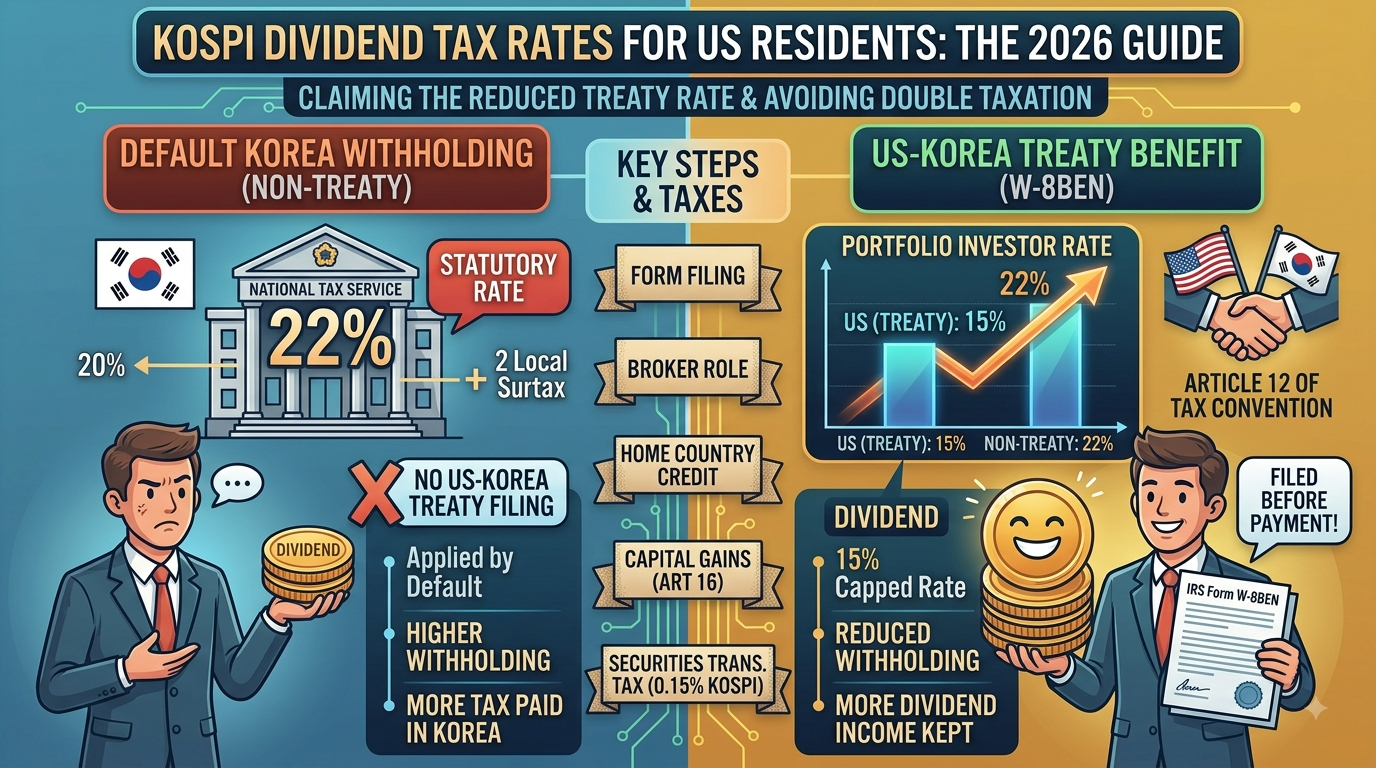
반응형US residents owning Korean stocks directly pay a 15% withholding tax on dividends under the US-Korea income tax treaty — well below Korea's 22% default non-treaty rate — provided they file the correct treaty benefit form with their broker before payment. This guide breaks down exactly how the rate works and how to claim it.
Table of Contents
- What's Korea's Default Dividend Withholding Rate?
- How the US-Korea Treaty Reduces That Rate
- How Do You Claim the Reduced Rate?
- Can You Claim a Foreign Tax Credit at Home?
- What About Capital Gains?
- The Securities Transaction Tax
- FAQ
What's Korea's Default Dividend Withholding Rate?
Korea's statutory withholding tax on dividends paid to non-resident investors is 22% — comprising a 20% national tax plus a 10% local surtax calculated on that national tax amount. This is the rate that applies by default, absent any tax treaty between Korea and the investor's home country.
 반응형
반응형How the US-Korea Treaty Reduces That Rate
Portfolio investor (individual/general) 15% Standard treaty rate, most US retail investors Corporate parent (≥10% voting stock ownership) 10% Qualifying direct investment relationship Non-treaty country investor 22% No applicable tax treaty with Korea Article 12 of the US-Korea Income Tax Convention caps withholding on portfolio dividends at 15%, and at 10% for qualifying corporate parent-subsidiary relationships. This 15% figure sits at the median of Korea's roughly 48 active tax treaties globally.
How Do You Claim the Reduced Rate?
- ☐ File IRS Form W-8BEN (individuals) or W-8BEN-E (entities) with your broker before the dividend payment date
- ☐ Confirm your broker applies the treaty rate automatically at source — most major international brokers handle this, but Korean brokerages may require it explicitly on account setup
- ☐ Retain dividend payment statements for your annual tax filing, showing gross dividend and tax withheld
- ☐ If withholding was incorrectly applied at the 22% default rate, a refund claim process exists through Korean tax authorities, though it involves additional documentation and processing time
Can You Claim a Foreign Tax Credit at Home?
US investors can generally claim a Foreign Tax Credit (via IRS Form 1116) for the Korean tax withheld, helping avoid double taxation on the same dividend income. The credit generally offsets US tax liability on that same income up to certain limits, though the precise calculation depends on your overall tax situation, and consulting a tax professional familiar with foreign investment income is strongly recommended for anything beyond a small position.
What About Capital Gains?
Under Article 16 of the treaty, capital gains are generally taxed only in the investor's country of residence, not in Korea — with important exceptions, most notably for gains tied to Korean real property or for investors who cross Korea's "major shareholder" ownership threshold (roughly defined around 1% ownership or a specified holding value, which varies by rule set in effect). Most retail foreign portfolio investors fall well below this threshold and owe no Korean capital gains tax on listed share sales.
The Securities Transaction Tax
Separate from income and capital gains tax, Korea levies a Securities Transaction Tax on share sales — 0.15% for KOSPI-listed stock sales as of recent rate schedules (KOSDAQ and other venues carry different rates). This applies regardless of investor residency or treaty status and is typically deducted automatically at the point of sale by your broker.
FAQ
Do I need to file anything with Korean tax authorities directly?
Most foreign portfolio investors don't need to file directly with Korean tax authorities, since withholding is handled at source by the paying company or broker — but this can vary based on account structure and investment size, so confirm with a tax professional.
What happens if I don't file the treaty benefit form?
Without a filed W-8BEN or equivalent, your broker may apply Korea's default 22% withholding rate rather than the reduced 15% treaty rate, though a refund claim process for the overwithheld amount typically exists.
Is the 15% rate the same for all countries, not just the US?
No — the rate depends on each country's specific tax treaty with Korea. The US rate of 15% happens to match Korea's median treaty rate across its roughly 48 treaty partners, but exact terms vary by country.
반응형'Investing Guides > Tax & Compliance' 카테고리의 다른 글
Short Selling Is Back in South Korea: How It Works and What Still Breaks (0) 2026.09.05 Foreign Ownership Limits on Korean Bank Holding Companies (0) 2026.08.25 Do Foreign Investors Pay Korean Inheritance Tax on KOSPI Shares? (0) 2026.08.22 How to Sell Korean Stocks and Repatriate Funds as a Foreigner (0) 2026.08.20 Foreign Ownership Limits on Korean Stocks: What to Know (0) 2026.08.19
Korean Stock & Equity Research
Data-driven analysis of Korean listed companies, combining financial fundamentals with supply chain and operations insights. Not investment advice.