-
Investing Guides/Tax & Compliance
Do Foreign Investors Pay Korean Inheritance Tax on KOSPI Shares?
2026. 8. 22.
Table
반응형Yes — Korean-listed shares are considered Korea-situs assets, so if a non-resident foreign investor dies holding KOSPI or KOSDAQ stock, that stock is subject to Korean inheritance tax regardless of the deceased's nationality or residence, though only a 200 million Won basic deduction applies (versus the far larger deductions available to Korean residents). There's no US-Korea estate tax treaty, so double taxation relief for US heirs runs through a foreign tax credit process instead. This article is part of our Ultimate Guide to Investing in South Korean Stocks for Foreigners.
Why Do Korean-Listed Shares Trigger Korean Inheritance Tax?
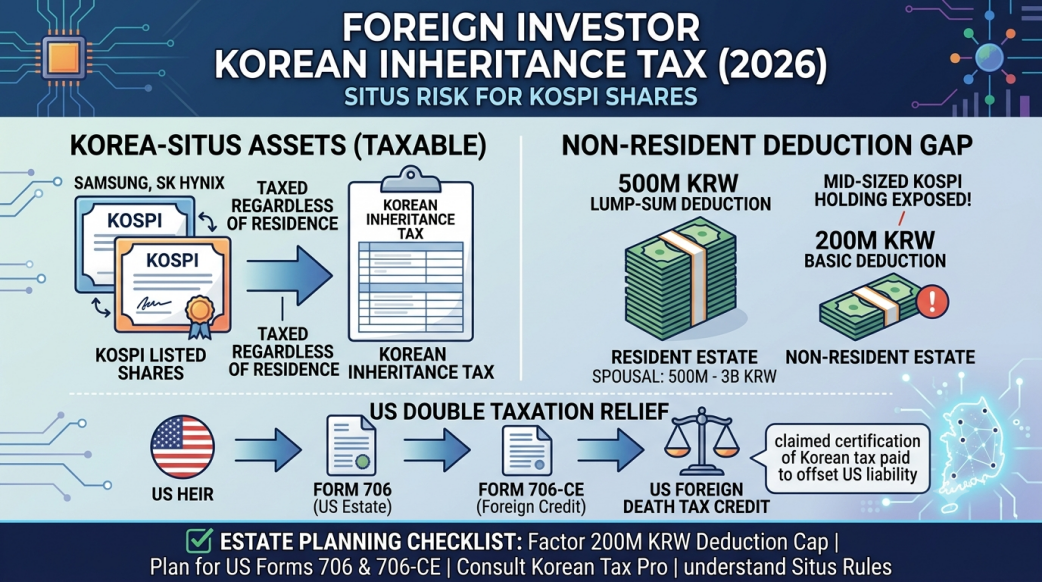
Korea's Inheritance and Gift Tax Act taxes non-residents on Korea-situs assets only — but shares in a Korean-listed company are considered Korea-situs regardless of where the deceased or the heir lives. This means a US investor holding Samsung Electronics or SK Hynix shares directly, who then passes away, exposes that holding to Korean inheritance tax even if they never set foot in Korea.
 반응형
반응형How Much Deduction Do Non-Resident Estates Get?
⚠️ The Non-Resident Deduction Gap
Korean-resident estates qualify for a 500 million Won lump-sum deduction plus a spousal deduction ranging from 500 million to 3 billion Won — deductions substantial enough to eliminate tax on many modest estates. Non-resident estates get only a single 200 million Won basic deduction, with no lump-sum or spousal deduction available. This gap catches many overseas families off guard, since a mid-sized KOSPI holding that would owe little or no tax under resident treatment can face meaningful Korean tax exposure under non-resident treatment.
What Are the Actual Tax Rates?
Korea applies progressive inheritance tax rates from 10% up to 50% depending on the taxable base, with an effective rate as high as 60% for certain controlling shareholder stakes. A significant reform took effect for the first time in 75 years, shifting the calculation basis from the total estate to each individual heir's inherited share — a structural change that can meaningfully affect the final tax bill depending on how many heirs are involved. Under this reform, foreign nationals classified as "short-term residents" (having lived in Korea five years or less within the past decade) are taxed only on Korean-situs assets, similar to full non-residents.
Is There a US-Korea Estate Tax Treaty?
No. The US and Korea have an income tax treaty (covering dividends, capital gains, etc.) but no separate estate or gift tax treaty. For US heirs, double taxation relief instead relies on the US foreign death tax credit under IRC Section 2014, claimed via IRS Form 706-CE to certify the Korean tax paid, which can offset US estate tax liability on the same Korea-situs shares — subject to per-country and overall limits.
✅ Estate Planning Checklist for Direct KOSPI Holdings
- Understand that Korean-listed shares are Korea-situs assets regardless of your residency
- Factor the 200 million Won non-resident deduction cap into estate size planning
- If US-based, plan for Form 706 (US estate) and Form 706-CE (foreign tax credit certification) filings
- Consult both a Korean tax professional and a cross-border estate planning attorney before large direct KOSPI positions, rather than after the fact
Frequently Asked Questions
Q1. Does holding EWY instead of direct KOSPI shares avoid Korean inheritance tax?
A. Generally yes — EWY is a US-domiciled fund, so it would typically be treated as a US-situs asset for estate purposes rather than Korea-situs, though this should be confirmed with a cross-border estate planning professional for your specific situation.
Q2. Who is responsible for filing and paying Korean inheritance tax on inherited KOSPI shares?
A. Heirs are individually liable based on their inherited share, though under Korean law heirs are also jointly liable for tax owed by other heirs up to the value of what they personally inherited.
Q3. Does Korea's inheritance tax apply the same way to gifts made during someone's lifetime?
A. Korea treats gift tax under a related but separate framework within the same Inheritance and Gift Tax Act; the situs-based logic for Korean-listed shares generally applies similarly, but specific thresholds and deductions differ from inheritance tax.
반응형'Investing Guides > Tax & Compliance' 카테고리의 다른 글
Short Selling Is Back in South Korea: How It Works and What Still Breaks (0) 2026.09.05 Foreign Ownership Limits on Korean Bank Holding Companies (0) 2026.08.25 How to Sell Korean Stocks and Repatriate Funds as a Foreigner (0) 2026.08.20 Foreign Ownership Limits on Korean Stocks: What to Know (0) 2026.08.19 KOSPI Dividend Tax Rates for US Residents (2026 Guide) (0) 2026.08.18
Korean Stock & Equity Research
Data-driven analysis of Korean listed companies, combining financial fundamentals with supply chain and operations insights. Not investment advice.