-
Investing Guides/Tax & Compliance
How to Sell Korean Stocks and Repatriate Funds as a Foreigner
2026. 8. 20.
Table
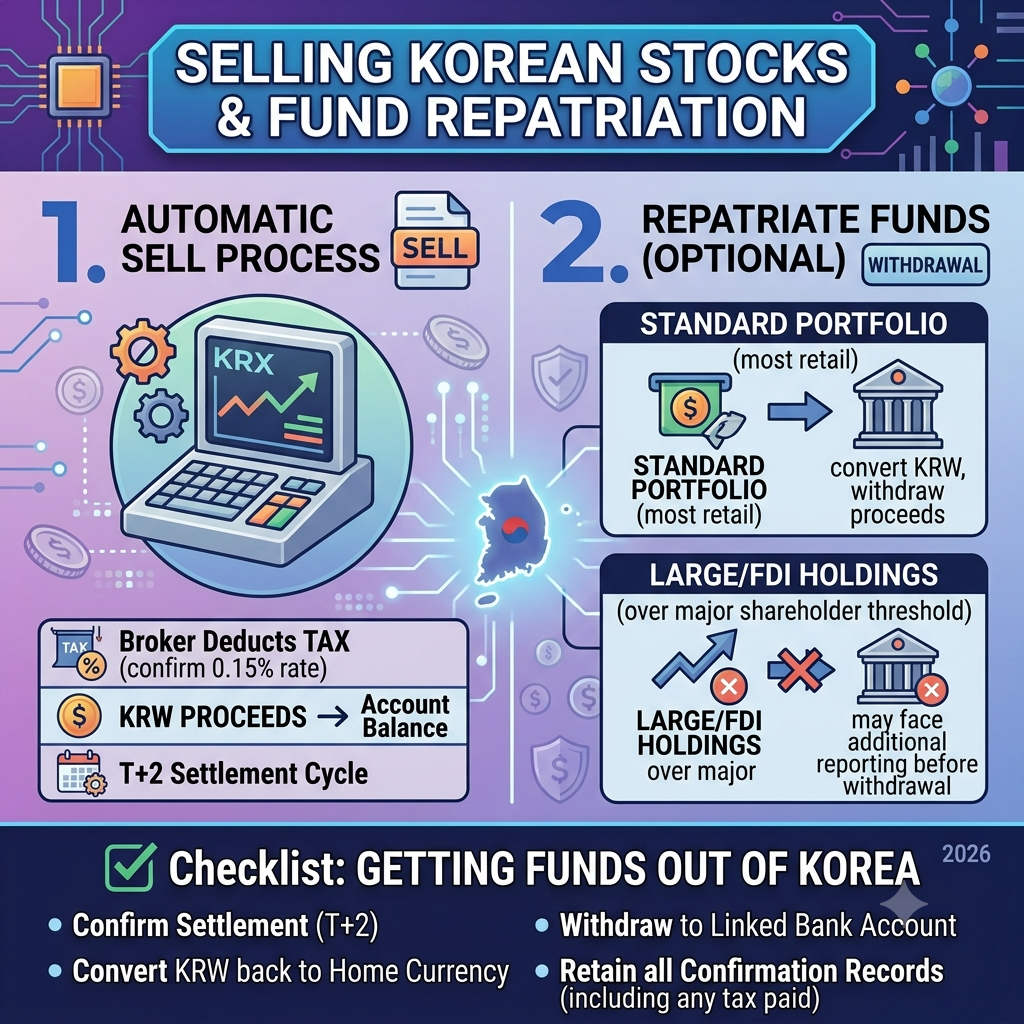
반응형Selling KOSPI-listed shares triggers Korea's Securities Transaction Tax (0.15% for KOSPI as of recent rate schedules), deducted automatically at the point of sale — after that, converting KRW proceeds back to your home currency and withdrawing them is generally straightforward through your existing broker, with no separate capital controls for standard portfolio investors below the major shareholder threshold.
This article is part of our Ultimate Guide to Investing in South Korean Stocks for Foreigners.
What Happens Automatically When You Sell?
When a sell order executes on KRX, two things happen automatically at the broker level: the Securities Transaction Tax is deducted from proceeds (confirm the current rate with your broker, as Korea periodically adjusts these rates), and the trade settles into your account's KRW cash balance — typically on a T+2 settlement cycle consistent with most global equity markets.
 반응형
반응형Do I Owe Capital Gains Tax When Selling?
For most foreign portfolio investors, no. As covered in our detailed tax guide, capital gains on listed Korean shares are generally not taxed for foreign investors who stay below Korea's "major shareholder" threshold (roughly defined around 1% ownership or a specified holding value, depending on the applicable rule set). Above that threshold, capital gains tax obligations can apply, and complex ownership structures should be reviewed with a tax professional before selling.
How Do I Get the Money Out of Korea?
✅ Fund Repatriation Checklist
- Confirm your KRW balance has fully settled (T+2) before initiating a withdrawal or conversion
- Convert KRW back to your home currency through your broker's standard FX process
- Withdraw funds to your linked bank account per your broker's standard transfer process
- Retain sale confirmation and settlement records for your annual tax filing, including any securities transaction tax paid
⚠️ Large or Control-Stake Sales May Face Additional Steps
Investors who crossed Korea's major shareholder threshold, or who acquired shares under a foreign direct investment (FDI) registration rather than as a standard portfolio investment, may face additional reporting requirements before repatriating proceeds. This doesn't apply to typical retail portfolio holdings, but should be checked in advance for any large or strategic position.
Frequently Asked Questions
Q1. Is there a limit on how much money I can repatriate from Korea?
A. Standard portfolio investors below the major shareholder threshold generally face no special repatriation limits; larger or FDI-registered positions may have additional procedural steps.
Q2. How long does settlement take after I sell?
A. Korean equity trades typically settle on a T+2 cycle, consistent with most major global equity markets.
Q3. Do I need to file anything with Korean authorities after selling?
A. Most standard portfolio investors don't need to file directly, since the securities transaction tax is withheld automatically at sale; confirm your specific situation with a tax professional if your position is large or complex.
반응형'Investing Guides > Tax & Compliance' 카테고리의 다른 글
Short Selling Is Back in South Korea: How It Works and What Still Breaks (0) 2026.09.05 Foreign Ownership Limits on Korean Bank Holding Companies (0) 2026.08.25 Do Foreign Investors Pay Korean Inheritance Tax on KOSPI Shares? (0) 2026.08.22 Foreign Ownership Limits on Korean Stocks: What to Know (0) 2026.08.19 KOSPI Dividend Tax Rates for US Residents (2026 Guide) (0) 2026.08.18
Korean Stock & Equity Research
Data-driven analysis of Korean listed companies, combining financial fundamentals with supply chain and operations insights. Not investment advice.