-
Investing Guides/Tax & Compliance
Foreign Ownership Limits on Korean Stocks: What to Know
2026. 8. 19.
Table
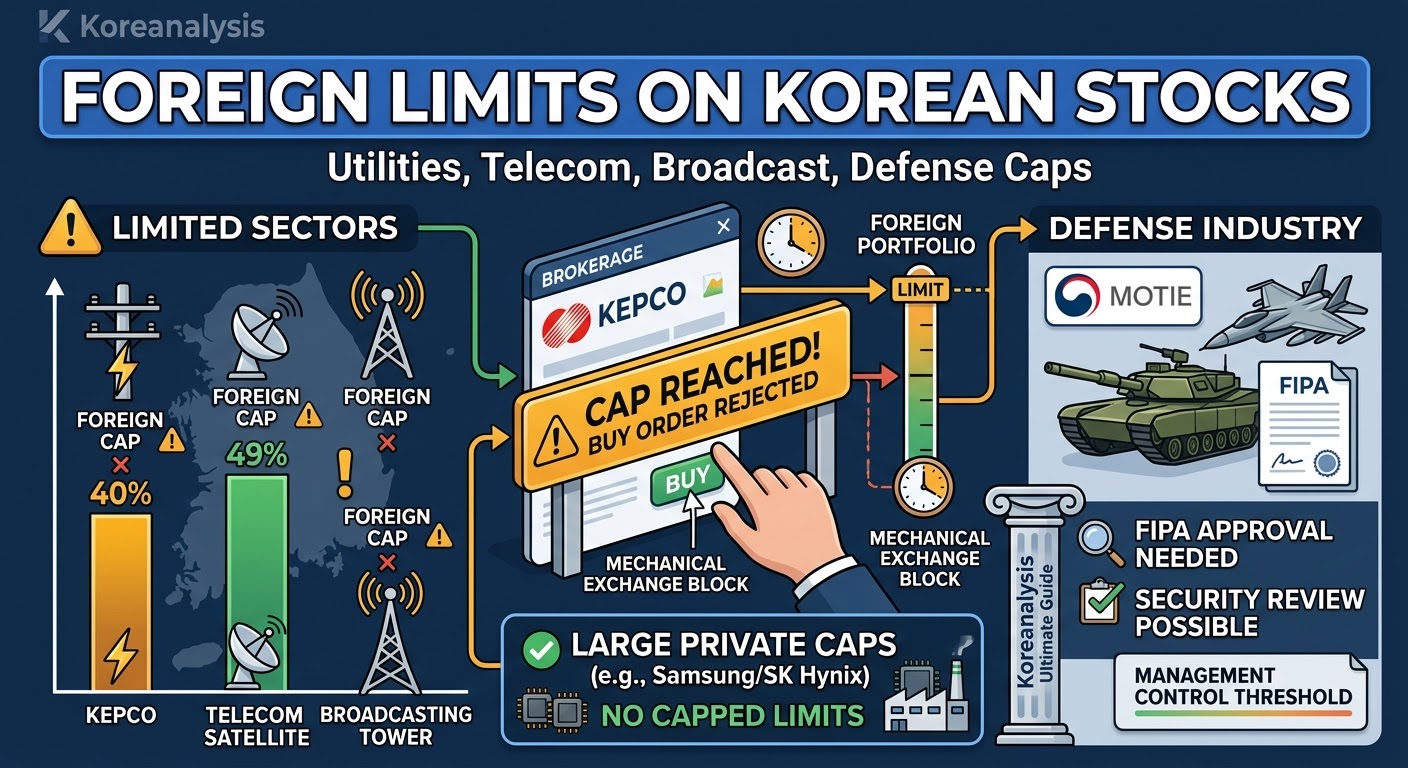
반응형Most Korean stocks carry no foreign ownership restrictions at all, but a small number of strategically sensitive sectors — utilities, broadcasting, telecom, and defense — cap total foreign ownership, and defense-related acquisitions face separate national security review under Korea's Foreign Investment Promotion Act. For most foreign portfolio investors buying Samsung Electronics or SK Hynix-type large caps, these caps are simply not relevant. This article is part of our Ultimate Guide to Investing in South Korean Stocks for Foreigners.
Which Sectors Actually Have Foreign Ownership Caps?
Korea has historically maintained ownership caps for state-linked or strategically sensitive companies, including entities such as Korea Electric Power Corporation (KEPCO) and select telecom and broadcasting companies, reflecting national infrastructure and media-policy considerations. These caps and their exact percentages are set by sector-specific statutes rather than a single unified rule, and have been periodically reviewed for relaxation as part of Korea's broader push for MSCI developed-market status — so always verify the current cap for a specific company directly with your broker or the company's own disclosure before trading, rather than relying on a fixed historical figure.
⚠️ What Happens When a Foreign Ownership Cap Is Reached?
Once aggregate foreign ownership in a capped stock hits its ceiling, exchanges typically restrict further foreign buy orders in that stock until ownership falls back below the threshold — meaning your buy order could simply be rejected at execution, even if your account and funds are otherwise in order. This is a mechanical, exchange-level block, not a punitive measure against any individual investor.
 반응형
반응형What About Defense Sector Investments Specifically?
Beyond simple ownership caps, investments in companies designated as "defense industry companies" by Korea's Ministry of Trade, Industry and Energy (MOTIE) require MOTIE approval under the Foreign Investment Promotion Act (FIPA), separate from standard brokerage account trading. A broader national security review can also be triggered if a foreign investment results in de facto management control of a domestic company and raises national security concerns — a threshold generally relevant to large strategic stakes rather than passive portfolio holdings.
✅ Before Buying a Strategically Sensitive Stock
- Check the company's current foreign ownership ratio via DART or your broker before placing a large order
- Confirm whether the sector (utilities, telecom, broadcasting, defense) carries a specific cap
- For large or control-oriented stakes, confirm whether FIPA notification or security review applies before proceeding
Frequently Asked Questions
Q1. Do foreign ownership caps apply to Samsung Electronics or SK Hynix?
A. No, large private-sector companies like Samsung Electronics and SK Hynix do not carry foreign ownership caps; these restrictions apply mainly to state-linked utilities, telecom, broadcasting, and defense-designated companies.
Q2. How would I know if a stock I want to buy has a foreign ownership cap?
A. Check the company's DART filings or ask your broker directly — exchange-level trading systems also typically flag or block orders once a stock's foreign ownership ceiling is reached.
Q3. Does buying a small number of shares in a defense company trigger a security review?
A. Generally no — security review and FIPA approval requirements are primarily triggered by acquisitions resulting in management control or influence, not passive minority portfolio positions, though thresholds can vary by case.
반응형'Investing Guides > Tax & Compliance' 카테고리의 다른 글
Short Selling Is Back in South Korea: How It Works and What Still Breaks (0) 2026.09.05 Foreign Ownership Limits on Korean Bank Holding Companies (0) 2026.08.25 Do Foreign Investors Pay Korean Inheritance Tax on KOSPI Shares? (0) 2026.08.22 How to Sell Korean Stocks and Repatriate Funds as a Foreigner (0) 2026.08.20 KOSPI Dividend Tax Rates for US Residents (2026 Guide) (0) 2026.08.18
Korean Stock & Equity Research
Data-driven analysis of Korean listed companies, combining financial fundamentals with supply chain and operations insights. Not investment advice.