-
Global Markets/Supply Chain & Geopolitics
Korea's Dawn Delivery Fight Isn't Really About Worker Health
2026. 9. 25.
Table
반응형Korea is debating whether to restrict deliveries between midnight and 5 a.m., officially framed as a courier health and safety measure — but the proposal comes from the traditional courier union bloc, not from Coupang's own delivery workforce, and it lands at the same moment Naver has chosen to restrict its own dawn delivery to paying members rather than compete for universal coverage. Read together, these are less a single health-policy story than a snapshot of who actually has leverage in Korea's fast-delivery economy, and it isn't obvious that courier health is the deciding factor for anyone involved.
반응형What's Actually Being Proposed in the Midnight Delivery Debate?
A courier union affiliated with the Korean Confederation of Trade Unions (KCTU) has proposed restricting parcel deliveries between midnight and 5 a.m., citing the health risks of overnight shift work. Under the proposal, dawn delivery itself wouldn't disappear — orders would still arrive by around 7 a.m. — but sorting and delivery would need to be separated, with sorting staff working the restricted overnight window and delivery drivers starting at 5 a.m. instead.
The response from the workers most directly affected has been notably negative. A survey of Coupang's own delivery couriers found 93% opposed restricting late-night delivery hours, with workers citing easier movement on empty roads, higher effective pay from more completed runs per shift, and greater schedule flexibility. Consumer groups have also pushed back, noting that roughly 20 million users rely on these services and that restaurants and households depend on genuinely fresh, early-morning delivery of perishables. Notably, even the more moderate Federation of Korean Trade Unions has favored a phased reduction in overnight hours rather than an outright ban, acknowledging that many workers actively prefer and rely on these shifts.
So Why Is a Health-Framed Ban Coming From Traditional Courier Unions?
This is where the structural story becomes clearer than the health framing suggests. Dawn delivery in Korea runs almost entirely through private logistics networks built and operated by Coupang and, in the fresh-grocery segment, by Kurly — companies whose delivery workforces sit largely outside the reach of the traditional parcel-courier unions organized under groups like the KCTU. Coupang alone accounts for roughly 37.6% of Korea's parcel delivery market. A restriction that pushed dawn delivery toward a slower, more traditional sort-then-deliver structure would, structurally, do more to erode the private, vertically integrated logistics model than it would to protect the health of workers who have said, in surveys, that they don't want the restriction.
None of this means the underlying health concern is fabricated — overnight shift work has real, well-documented health costs, and it would be a mistake to dismiss the union position as pure self-interest. But the specific shape of the proposal, and the fact that its strongest opposition comes from the very workers it claims to protect, is a meaningful signal that labor-market competition between old and new logistics models is doing at least as much work here as worker welfare.
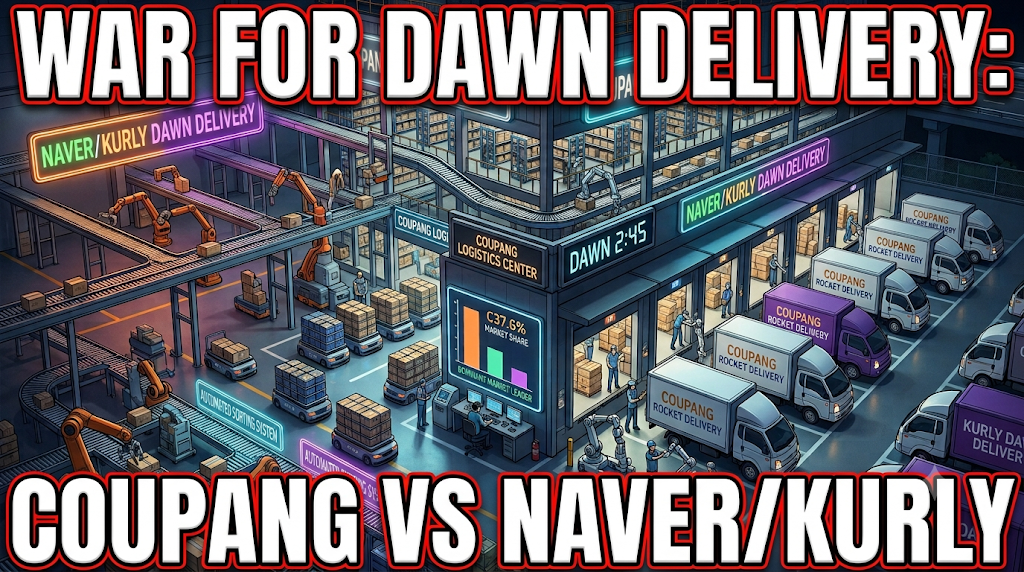
Coupang vs. Naver: Two Different Answers to the Same Cost Problem
Company Dawn Delivery Access Coverage Strategy Coupang (Rocket Fresh) Open to all customers $2.2B invested to expand from ~70% to 88% national coverage by 2027 Naver (via Kurly) Naver Plus members only, from late Nov 2026 Concentrated in Seoul/Gyeonggi; membership-gated rather than geography-expanded Why Is Naver Restricting Its Own Dawn Delivery Right Now?
Starting in late November 2026, Naver will convert its dawn delivery service — run through its partnership with grocery platform Kurly — into a benefit exclusive to Naver Plus membership subscribers. Under the current system, any customer buying an eligible product gets dawn delivery regardless of membership status; after the switch, non-members will instead receive next-day delivery, while same-day delivery for orders placed before 11 a.m. remains unchanged for everyone.
The economics behind this are straightforward. Kurly's cold-chain dawn delivery is the most expensive delivery method in the industry, since overnight staffing costs run roughly double daytime rates and refrigerated packaging adds further cost, and Naver pays Kurly for that infrastructure. Restricting the service to paying members lets Naver offset part of that cost through subscription revenue while also using faster delivery as a lock-in mechanism to drive new membership signups — the company has described the goal internally as building a "virtuous cycle" where membership drives platform engagement, which drives repeat purchasing, which justifies further investment in membership benefits.
⚠️ Don't read Naver's move as a sign it's winning this race
Restricting dawn delivery to paying members is also a tacit admission that Naver, via Kurly, cannot match Coupang's cost structure or geographic reach on an open basis. Kurly's dawn delivery footprint remains concentrated in Seoul and Gyeonggi Province, with only limited coverage in a handful of other metro areas, while Coupang has committed $2.2 billion specifically to push national coverage from roughly 70% to 88% by 2027. Gating access to paying members is a reasonable response to a genuine cost disadvantage, but it is a defensive move, not evidence Naver has closed the structural gap with Coupang.
Could Automation Make This Whole Debate Irrelevant?
There's a longer-term wrinkle that neither the health-rights framing nor the Coupang-Naver rivalry fully addresses: the labor-intensive delivery model both companies currently rely on may not exist in its current form for much longer. Amazon, the closest global analog, announced plans in late 2025 to cut up to 30,000 corporate roles — nearly 10% of its corporate workforce — while separately outlining automation and robotics plans aimed at avoiding the need to hire for as many as 600,000 additional warehouse and logistics roles by 2033, out of a workforce of roughly 1.55 million. Korea's own logistics operators are moving in the same direction, with sorting-center automation and delivery-robot pilots already underway at a smaller scale.
If that trajectory holds, the current fight over who staffs the midnight-to-5-a.m. shift may be a fight over a workforce that shrinks substantially within the next decade regardless of how this specific regulatory dispute is resolved — a reason the courier unions' urgency about protecting shift conditions now is, in its own way, rational even if the stated health framing isn't the full story.
✅ What to watch from here
- Whether Korean regulators move toward the KCTU-affiliated union's midnight-5am restriction, a phased compromise along the lines the Federation of Korean Trade Unions has proposed, or no change at all.
- Whether Naver's membership-gated dawn delivery meaningfully grows Naver Plus subscriptions once it launches in late November 2026, or whether customers simply default to Coupang for dawn delivery instead.
- Whether Coupang hits its 88%-national-coverage target by 2027, which would widen its structural advantage over Naver/Kurly's more geographically concentrated model.
A health-framed proposal that 93% of the workers it claims to protect actively oppose is worth reading as a labor-market power struggle first and a health policy second.
What Should Investors Watch Next?
This dispute sits at the intersection of two larger themes Koreanalysis has tracked separately — Korean e-commerce's escalating capital investment race and the broader global question of how quickly logistics automation displaces delivery labor. How Korean regulators ultimately balance courier welfare against the reality that most affected workers oppose the proposed fix is likely to be read by markets as a signal of how much regulatory risk Coupang and Naver's logistics investments carry going forward.
Frequently Asked Questions
Q1. Is Korea banning dawn delivery?
A. Not currently. A KCTU-affiliated courier union has proposed restricting deliveries specifically between midnight and 5 a.m., which would still allow dawn delivery to arrive by around 7 a.m. under a restructured sort-then-deliver model. No restriction has been enacted as of this writing, and a survey found 93% of Coupang's own couriers opposed it.
Q2. Why is Naver restricting its dawn delivery to paying members?
A. Naver's dawn delivery runs through a partnership with Kurly, whose cold-chain overnight logistics are the most expensive delivery method in the industry. Making dawn delivery a Naver Plus membership benefit starting in late November 2026 lets Naver offset those costs through subscription revenue while also using faster delivery to drive membership signups.
Q3. How does Coupang's dawn delivery coverage compare to Naver's?
A. Coupang has committed $2.2 billion to expand Rocket Delivery coverage from roughly 70% to 88% of the country by 2027 and offers dawn delivery to all customers. Naver's dawn delivery, run through Kurly, remains concentrated mainly in Seoul and Gyeonggi Province and will become membership-gated rather than geographically expanded.
A health-framed proposal that 93% of the workers it claims to protect actively oppose is worth reading as a labor-market power struggle first and a health policy second.
반응형'Global Markets > Supply Chain & Geopolitics' 카테고리의 다른 글
Why a US Diesel Export Ban Would Be a Win for Korea (0) 2026.09.30 Why Saudi Arabia's Oil Pipeline Keeps Getting Attacked (0) 2026.09.26 Nike Just Left the S&P 100 — Is Its 4.4% Dividend a Trap? (0) 2026.09.23 Why Is Korea Stalling Its $350 Billion US Investment Deal? (0) 2026.09.20 Korea's $350B US Pledge: The Texas Project and the Fine Print (0) 2026.09.11
Korean Stock & Equity Research
Data-driven analysis of Korean listed companies, combining financial fundamentals with supply chain and operations insights. Not investment advice.