-
Global Markets/Supply Chain & Geopolitics
Nike Just Left the S&P 100 — Is Its 4.4% Dividend a Trap?
2026. 9. 23.
Table
반응형Nike exited the S&P 100 index on September 21, 2026, ending an 18-year run, after its stock collapsed roughly 78% from its November 2021 peak and its market capitalization fell below the threshold blue-chip status requires. The decline has pushed Nike's dividend yield above 4.4% — the highest in the entire Dow Jones Industrial Average — which is exactly the kind of number that makes a stock look either like a bargain hiding in plain sight, or a value trap dressed up as one.
반응형Why Did Nike Actually Get Removed From the S&P 100?
The mechanical reason is straightforward: S&P 100 membership is driven by market capitalization ranking among S&P 500 companies, and Nike's market value has fallen too far to qualify. Nike lost more than $200 billion in market capitalization since peaking near $264 billion in November 2021, with the stock falling from $179.10 to roughly $37–38 today. Dell Technologies, SanDisk, and other technology names took Nike's place, continuing a broader shift in the index toward servers and data infrastructure companies. Nike remains in the S&P 500 and, for now, the Dow Jones Industrial Average — but the S&P 100 exit is the clearest institutional signal yet that Wall Street no longer treats Nike as a top-tier blue chip.
The underlying business problems are less mechanical and more structural. Nike's fiscal 2026 revenue declined roughly 2% on a currency-neutral basis, direct-to-consumer revenue fell 6% to $17.7 billion, and Greater China sales fell in the double digits for an eighth consecutive quarter of decline. None of this happened overnight — it's the accumulated result of strategic choices Nike made years earlier that are still working their way through the business.
What Actually Went Wrong Inside Nike?
Three separate decisions compounded into the current collapse. First, during the pandemic, then-CEO John Donahoe bet heavily that Nike.com and Nike-owned stores would permanently replace wholesale retail, cutting ties with longtime department-store and specialty retail partners to push toward a direct-to-consumer model. When in-person shopping recovered post-pandemic, those abandoned retail shelves were filled by competitors — On Running, Hoka, and New Balance among them — who gained share Nike had voluntarily vacated.
Second, Nike's product innovation cycle slowed. Running-shoe performance is driven largely by midsole technology — Nike's ZoomX and Air Zoom, competitors' equivalents like Adidas's Boost or Asics's FF Blast — and where rivals refresh their midsole technology annually, Nike moved to a roughly two-year cycle, filling the gaps with colorway and upper-design changes rather than genuine technical advances. Consumers, who mostly perceive "newness" through midsole changes, noticed the slowdown.
Third, Nike leaned heavily into cause-driven, "inclusive marketing" campaigns — most famously making Colin Kaepernick the face of a 2018 campaign after his national-anthem protests, and later expanding plus-size marketing with prominent in-store mannequins and campaigns. The Kaepernick campaign was a short-term commercial success, with online sales reportedly rising about 31% in the days following its launch. But the years of amplified culture-war attention that followed left Nike's brand image increasingly polarized, and by John Donahoe's October 2024 departure — replaced by Nike veteran Elliott Hill — the company had begun quietly shifting marketing emphasis back toward product rather than social messaging.
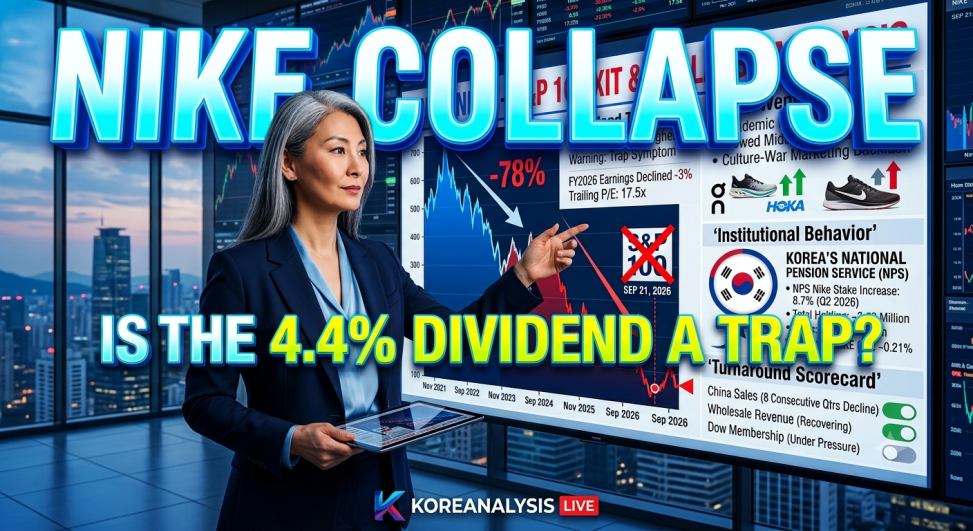
Nike's Turnaround Scorecard
Metric Figure Stock decline from Nov 2021 peak ~78% Market cap lost since peak $200B+ Current dividend yield ~4.4% (highest in the Dow) Trailing P/E ~17.5x ⚠️ A high dividend yield is a symptom, not proof of a bargain
Nike's 4.4% yield looks attractive next to the rest of the Dow, and the company has raised its dividend for 24 consecutive years with $9 billion of cash on hand and $46.4 billion in revenue behind it. But fiscal 2026 earnings actually fell about 3% despite roughly flat revenue, China sales remain down double digits, and digital sales are down about 12%. At 17.5x trailing earnings, Nike isn't obviously cheap for a company still mid-turnaround — buying here means betting on Elliott Hill's recovery plan working, not buying a business that has already stabilized.
What Is Korea's National Pension Service Doing With Its Nike Stake?
This is where the story becomes directly relevant to Korean investors rather than a purely American retail tale. Korea's National Pension Service (NPS) — one of the world's largest institutional investors — disclosed in a filing covering the second quarter of 2026 that it increased its Nike position by 8.7%, adding roughly 247,230 shares to bring its total holding to about 3.09 million shares, valued near $126.8 million and representing roughly 0.21% of Nike's outstanding stock. That stake increase came during a period when Nike's stock was already deep into its multi-year decline and heading toward its S&P 100 exit — meaning NPS was adding exposure into the weakness rather than trimming it.
That said, NPS's Nike position has not moved in a straight line this year; earlier-2026 filings reportedly showed the fund trimming its Nike holdings before the second-quarter filing showed the increase, a reminder that even large, patient institutional investors adjust position size incrementally rather than making one-time, permanent calls on a name like Nike.
✅ What to watch for signs of a real turnaround
- Whether Greater China sales stop declining — an eighth consecutive quarter of decline there means this is the single most important number in any future Nike earnings report.
- Whether wholesale revenue keeps recovering (it rose about 6% in fiscal 2026) as a sign that Elliott Hill's retail-partner rebuild is working.
- Whether Nike's Dow Jones Industrial Average membership itself comes under pressure — the S&P 100 exit is one blue-chip marker gone; the Dow is the next one analysts are watching.
Nike's S&P 100 exit didn't create its problems — it just made official what the stock price had already been signaling for years: this is a turnaround story now, not a growth story.
What Should Investors Watch Next?
Nike's situation is worth watching alongside how other global consumer brands navigate the same tension between cause-driven marketing and core product focus, since Nike is unlikely to be the last major brand to face this exact trade-off. It's also a useful real-world case study in how index-committee mechanics — S&P 100 inclusion, and potentially Dow membership down the line — can lag or lead a stock's actual business fundamentals, a dynamic Koreanalysis may revisit in future coverage of index reconstitution events.
Frequently Asked Questions
Q1. Why was Nike removed from the S&P 100?
A. Nike's market capitalization fell below the threshold required for S&P 100 membership after its stock dropped roughly 78% from its November 2021 peak, losing more than $200 billion in market value. It was replaced by Dell Technologies, SanDisk, and other technology companies on September 21, 2026, while remaining in the S&P 500.
Q2. Is Nike's high dividend yield a sign it's undervalued?
A. Not necessarily. Nike's roughly 4.4% yield is the highest in the Dow and backed by 24 consecutive years of dividend increases, but fiscal 2026 earnings fell about 3% and China and digital sales remain weak. At about 17.5x trailing earnings, Nike is priced as a company mid-turnaround rather than as an obvious bargain.
Q3. Does Korea's National Pension Service still hold Nike stock?
A. Yes. A filing covering the second quarter of 2026 showed the NPS increased its Nike stake by 8.7%, to roughly 3.09 million shares worth about $126.8 million, or about 0.21% of Nike's outstanding stock — even as Nike's stock remained deep in its multi-year decline.
Nike's S&P 100 exit didn't create its problems — it just made official what the stock price had already been signaling for years: this is a turnaround story now, not a growth story.
반응형'Global Markets > Supply Chain & Geopolitics' 카테고리의 다른 글
Why Saudi Arabia's Oil Pipeline Keeps Getting Attacked (0) 2026.09.26 Korea's Dawn Delivery Fight Isn't Really About Worker Health (0) 2026.09.25 Why Is Korea Stalling Its $350 Billion US Investment Deal? (0) 2026.09.20 Korea's $350B US Pledge: The Texas Project and the Fine Print (0) 2026.09.11 What Takaichi's Japan Means for South Korean Investors (0) 2026.09.06
Korean Stock & Equity Research
Data-driven analysis of Korean listed companies, combining financial fundamentals with supply chain and operations insights. Not investment advice.