-
Global Markets/Supply Chain & Geopolitics
Why Saudi Arabia's Oil Pipeline Keeps Getting Attacked
2026. 9. 26.
Table
반응형Saudi Arabia's East-West pipeline — the one alternative route for its oil exports whenever the Strait of Hormuz is unsafe — was shut down for nine days in September 2026 after a drone strike traced to launch sites inside Iraq, part of a wave of attacks that Saudi officials say has topped nearly 1,000 since February. The pipeline is running again as of September 22, but the deeper problem hasn't gone away: neither Iraq's government nor Saudi Arabia's own military command structure has been able to fully stop these attacks, and Washington has so far chosen to help with intelligence rather than firepower.
반응형What Actually Happened to Saudi Arabia's East-West Pipeline?
On September 10-11, 2026, drones struck a section of Saudi Arabia's East-West Crude Oil Pipeline along its route between Medina and Mahd Al-Dhahab, triggering fires and injuring several people, though no deaths were reported. Saudi Aramco shut the 1,200-kilometer pipeline down as a precaution. That mattered more than a typical infrastructure outage would, because the pipeline — often called Petroline — is Saudi Arabia's main workaround whenever the Strait of Hormuz becomes too dangerous to use, and it was carrying an estimated 4-5 million barrels a day at the time it was hit. The kingdom's crude output had already slipped to roughly 6.24 million barrels a day in August amid related pipeline disruptions. Saudi Arabia restarted the pipeline on September 22, after a nine-day shutdown, and responded by loading extra supertankers out of its Gulf terminals in the meantime — a sign it was leaning harder on the Strait of Hormuz route rather than waiting out the Red Sea risk.
Why Do These Drone Attacks Keep Coming From Iraq?
Saudi Arabia's Foreign Ministry said the drones that hit the pipeline were launched from Iraqi territory, and Iraqi authorities confirmed it: an investigation traced the launch to Maysan governorate in southern Iraq, near the Sheeb border crossing east of Amara, and Iraq's prime minister dismissed the military commander who oversaw operations there. Iraqi security officials later said they had seized the drone-launching equipment itself, while stressing what one Iraqi general called a policy of "preventive sovereignty" — not just defending Iraqi territory, but not letting it be used as a launchpad against a neighbor either. That's a harder promise to keep than it sounds. According to Wall Street Journal reporting on Saudi estimates, close to 1,000 drone attacks have targeted the kingdom since the war between the U.S., Israel, and Iran began in late February 2026, and up to half of them are believed to have originated from Iraqi soil — carried out by Iran-aligned militias operating under Iraq's Popular Mobilization Forces umbrella, a paramilitary structure Iraq's own government only partially controls. The same pattern showed up in May, when Saudi Arabia and the UAE both reported drones entering from Iraq's direction within the same 48-hour window, one of which struck near the UAE's Barakah nuclear plant.
Date (2026) Event Feb 28 U.S.-Israel strikes on Iran open the wider war; Iran later moves to close the Strait of Hormuz May 17-19 Iraq-launched drones hit Saudi Arabia and the UAE within 48 hours Jul 20-22 Houthis declare a maritime blockade on Saudi Arabia and strike two Saudi oil tankers, Encelia and Layla Sep 10-11 Iraq-origin drones hit the East-West pipeline; Saudi Aramco shuts it down Sep 22 Pipeline resumes operation after a 9-day shutdown 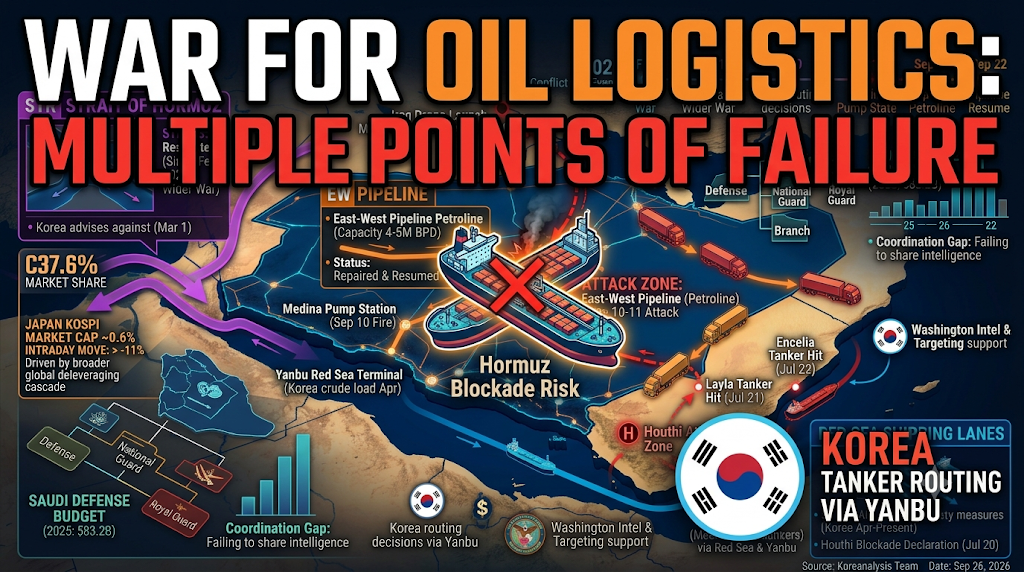
Why Can't Saudi Arabia's Own Military Stop This?
It isn't a budget problem. Saudi Arabia spent an estimated $83.2 billion on defense in 2025, the eighth-highest military budget in the world. The problem, according to defense analysts, is structural: alongside the regular armed forces under the Defense Ministry, the Saudi monarchy maintains a separate National Guard and a Royal Guard, a deliberate arrangement meant to prevent any single military branch from being powerful enough to attempt a coup. That same arrangement makes the branches reluctant to share intelligence or coordinate operations with each other, which has real consequences on the ground — analysts have pointed to Saudi forces failing to detect the assembly of what is now estimated at roughly 350,000 Houthi fighters, against a Saudi active-duty force of around 250,000. This isn't a new pattern. Houthi forces claimed a major battlefield victory over Saudi-led troops in Najran province back in 2019, saying they killed more than 500 and captured over 2,000 — though independent military analysts at the time judged those specific figures to likely be exaggerated, even while agreeing a real Saudi-led defeat had occurred. On the missile-defense side, the U.S. State Department approved a $15 billion sale of THAAD systems to Saudi Arabia back in October 2017; the kingdom's first THAAD battery didn't actually go operational until 2025 — an eight-year gap between purchase and activation that left a real air-defense hole open through most of the current conflict.
⚠️ A structural weakness isn't the same as a battlefield collapse
It's worth being careful here: a fragmented command structure and an activation gap on missile defense are real, documented weaknesses, but Saudi Arabia is not close to losing control of its own territory or its main oil infrastructure. The pipeline has been repeatedly hit, not permanently disabled, and it was back in service within nine days. The story isn't "Saudi Arabia is losing" — it's that a $83 billion-a-year military built primarily to survive internal threats is proving slower and less coordinated than it needs to be against a swarm of cheap drones coming from outside its own airspace.
Why Won't the U.S. Just Strike Back Directly?
Crown Prince Mohammed bin Salman has reportedly pressed President Trump directly, in multiple phone calls, for the U.S. to take a more active military role against the Houthis and Iran-aligned militias in Iraq. So far, the answer from Washington has been intelligence and targeting support rather than direct strikes — U.S. Central Command's Admiral Brad Cooper visited Saudi Arabia to help coordinate exactly that kind of support, while a senior U.S. official framed the American role as "empowering our regional partners to take the lead" rather than leading the fight itself. Part of the reason isn't hard to guess: global oil prices climbing toward $107 a barrel by mid-September, less than two months before the U.S. midterm elections, is not a backdrop in which a U.S. administration wants to be seen opening a new, open-ended front in the Middle East. Trump himself has publicly predicted oil prices will fall after the election and accused Iran of trying to keep prices elevated specifically to hurt Republican prospects.
✅ What to watch from here
- Whether Iraq's government can actually rein in Iran-aligned militias operating from its territory, beyond dismissing individual commanders after the fact
- Whether the Houthis' July blockade declaration on Saudi shipping escalates again, or stays at its current reduced tempo
- Whether a further oil-price spike before the November U.S. midterms changes Washington's calculus on direct military involvement
Saudi Arabia's problem isn't that it can't afford security — it's that money alone can't buy a unified chain of command overnight, or a neighboring government's full control over its own militias.
What Does This Mean for Korea?
Korea has direct, practical exposure to this story through its own shipping decisions. When the broader war closed off safe passage through the Strait of Hormuz, Korean authorities initially advised tankers against using the Red Sea route as well, starting March 1, 2026. By April, with the Hormuz disruption looking like it would drag on, Korea's Ministry of Trade, Industry and Energy and Ministry of Oceans and Fisheries reversed course and began allowing Korean-flagged crude tankers meeting certain safety requirements to transit the Red Sea via Saudi Arabia's Yanbu port instead — a direct routing decision shaped by exactly the kind of Red Sea and pipeline security questions raised in this piece. That makes Saudi Arabia's ability to keep both the Strait of Hormuz workaround (the pipeline) and the Red Sea route itself secure a genuinely practical question for Korean oil logistics, not just a geopolitical curiosity.
What Should Investors Watch Next?
The bigger picture here is a Middle East oil-supply system that now has multiple points of failure at once — the Strait of Hormuz, the East-West pipeline, and the Red Sea shipping lanes — with no single actor currently able to secure all three. How this settles out over the next few months, particularly around the U.S. midterms and whatever comes of Iraq's promises to control militias on its soil, is likely to keep showing up in oil price volatility well beyond this one pipeline incident. Korea's own tanker-routing decisions through the Red Sea are a topic Koreanalysis may return to as a standalone piece if the security picture there changes materially.
Frequently Asked Questions
Q1. Why is Saudi Arabia's East-West pipeline so important?
A. It's Saudi Arabia's main alternative export route when the Strait of Hormuz is unsafe or blocked, capable of carrying an estimated 4-5 million barrels of crude a day from the Eastern Province to the Red Sea coast, bypassing Hormuz entirely.
Q2. Who is responsible for the drone attacks on Saudi Arabia?
A. Saudi and Iraqi investigations traced the September 2026 pipeline attack to a launch site in Iraq's Maysan governorate. More broadly, Wall Street Journal reporting citing Saudi estimates found that up to half of nearly 1,000 drone attacks on the kingdom since February 2026 originated from Iraqi territory, attributed to Iran-aligned militias operating under Iraq's Popular Mobilization Forces umbrella.
Q3. Is the pipeline still shut down?
A. No. Saudi Aramco restarted the East-West pipeline on September 22, 2026, after a nine-day shutdown, though the underlying security risk to both the pipeline and Red Sea shipping lanes has not been fully resolved.
Saudi Arabia's problem isn't that it can't afford security — it's that money alone can't buy a unified chain of command overnight, or a neighboring government's full control over its own militias.
반응형'Global Markets > Supply Chain & Geopolitics' 카테고리의 다른 글
Why a US Diesel Export Ban Would Be a Win for Korea (0) 2026.09.30 Korea's Dawn Delivery Fight Isn't Really About Worker Health (0) 2026.09.25 Nike Just Left the S&P 100 — Is Its 4.4% Dividend a Trap? (0) 2026.09.23 Why Is Korea Stalling Its $350 Billion US Investment Deal? (0) 2026.09.20 Korea's $350B US Pledge: The Texas Project and the Fine Print (0) 2026.09.11
Korean Stock & Equity Research
Data-driven analysis of Korean listed companies, combining financial fundamentals with supply chain and operations insights. Not investment advice.