-
Global Markets/Supply Chain & Geopolitics
Why a US Diesel Export Ban Would Be a Win for Korea
2026. 9. 30.
Table
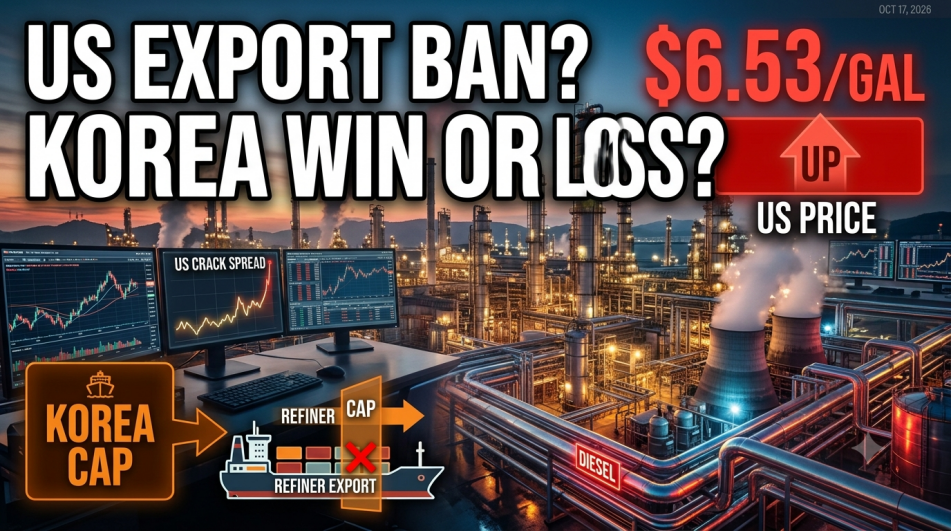
반응형Five of the world's biggest diesel-exporting regions — the Middle East, Russia, China, the US, and Korea — are all constrained right now, which is why US diesel hit a record $6.53 a gallon in September 2026 and why the Trump administration is seriously weighing a diesel export ban. Korea is the odd one out on that list: its refiners aren't short of diesel at all, they're just capped by their own government's export restriction, sitting on the widest refining margins in years while demand from everyone else's shortage goes largely unmet. If Washington actually bans diesel exports, that squeeze gets tighter still — and Korean refiners' opportunity cost climbs right along with it.
반응형Why Did a US-China Summit Fact Sheet Mention Refined Oil Products?
At the Trump-Xi summit held September 25-26, 2026, the White House's official fact sheet included one specific line buried between sections on tariffs and AI: "President Trump urged President Xi to increase production of refined petroleum products to stabilize global supply." That's an unusual level of specificity for a fact sheet mostly about tariff schedules and soybean purchases, and it tells you how seriously Washington is now treating the refined-fuel market specifically — not crude oil, but diesel and gasoline. The reason isn't abstract: four days before the summit's diesel language was published, AAA data showed US diesel at a record $6.527 a gallon.
Why Is US Diesel at a Record $6.53 a Gallon?
US diesel inventories are near their lowest level since 1996 — roughly a 30-year trough — even as refiners are running close to full capacity. Diesel demand typically rises in the fall as farmers need fuel for harvest, right as refineries head into seasonal maintenance that temporarily reduces output, and that seasonal squeeze is landing on top of a market that's already lost supply from multiple directions. According to industry tracking, the US diesel crack spread (the refining margin specific to turning crude into diesel) hit a record intraday peak of about $102 a barrel in mid-August 2026, roughly 15% above the previous all-time high set in October 2022, driven by the combination of Strait of Hormuz disruptions, Ukrainian drone strikes on Russian refineries, Houthi strikes on Saudi Arabia's Jazan refining complex, and Libyan refinery damage all landing at once.
Exporter Why Supply Is Constrained Middle East Strait of Hormuz disruption and direct refinery attacks (e.g. Saudi Arabia's Jazan complex) Russia Ukrainian drone strikes on refineries; Russia has restricted its own diesel exports to cover domestic shortfalls China Export curbs imposed after the Hormuz closure, eased gradually since July as domestic stockpiles proved ample United States Diesel inventories near a 30-year low despite near-full refinery utilization; a domestic export ban is under active consideration Korea Not supply-constrained — capped since March 2026 by its own government export restriction Would a US Diesel Export Ban Actually Lower Prices?
Treasury Secretary Scott Bessent has said the administration is "examining whether it's feasible in terms of the overall refining capacity and whether a full or partial ban would work." Iowa Senator Chuck Grassley has pushed for a ban as prices climb ahead of the November midterms, while other Republicans, including Texas Senator John Cornyn, have dismissed the idea as a political "gimmick."
⚠️ A ban might not do what it's sold as doing
Several major banks have pushed back on the idea that a ban is a clean fix. Analysts at multiple institutions have warned a diesel export ban would likely lower US diesel prices only temporarily, and could backfire by pushing gasoline prices higher as refiners shift their product mix — American Petroleum Institute CEO Mike Sommers has argued a ban "would only compound the problem" rather than solve it. In other words: treat "ban diesel exports, prices fall" as a real possibility under discussion, not a settled outcome.
Why Are Korean Refiners Sitting on a Missed Opportunity?
Korea is genuinely unusual on this list because its constraint is entirely self-imposed. Since March 13, 2026, Korea's Ministry of Trade, Industry and Energy has capped gasoline, diesel, and kerosene exports at the prior year's levels, a measure explicitly aimed at protecting domestic fuel supply and price stability rather than any shortage on Korea's end. Korea's four major refiners — SK Energy, GS Caltex, S-Oil, and HD Hyundai Oilbank — set a diesel export record in 2025 regardless, shipping roughly 202 million barrels, or about 42% of Korea's total petroleum product exports of 485 million barrels. That was before this year's margin surge: industry tracking has put Asia's composite refining margin well above $80 a barrel at points in 2026, up sharply from where it started the year, and Korean refiner stocks have moved accordingly — SK Innovation and S-Oil both posted notable single-day gains as the Russia diesel ban news spread through markets in July. The frustrating part for the industry is straightforward: every barrel Korea's refiners could sell abroad at today's elevated prices, but can't because of the export cap, gets redirected to the domestic market instead — a real opportunity cost the industry is absorbing so that Korean consumers don't feel the global squeeze as directly.
✅ What to watch from here
- Whether the Trump administration actually implements a diesel export ban, full or partial, and how banks' predicted gasoline-price backfire plays out in practice
- Whether China's refined-fuel export policy tightens again if Hormuz-related risk resurfaces, after its gradual easing since July
- Whether Korea's own export cap, in place since March 2026 with no stated end date, gets revisited if global refining margins stay this elevated
Korea is the one major diesel exporter in this squeeze that isn't actually short of fuel — it's just not allowed to sell what it has at today's prices.
What Should Investors Watch Next?
The diesel crunch is really a proxy for a broader story this project has been tracking all year: multiple, simultaneous disruptions to global refined-fuel supply chains, from the Middle East conflict to Russia's war-damaged refineries to Washington's own domestic-price politics, all converging at once. How long China keeps its export policy flexible, and whether Korea's export cap survives contact with a full US diesel export ban, are both threads worth following as this plays out into the US midterms and beyond.
Frequently Asked Questions
Q1. Why is US diesel so expensive right now?
A. US diesel inventories are near a 30-year low, refineries are entering seasonal fall maintenance just as agricultural demand rises, and global supply has been hit simultaneously by Middle East conflict disruptions, Ukrainian strikes on Russian refineries, and export restrictions from multiple major producers.
Q2. Why can't Korean refiners just export more diesel to take advantage of high prices?
A. Since March 13, 2026, Korea's government has capped gasoline, diesel, and kerosene exports at prior-year levels to protect domestic fuel supply and pricing, regardless of how attractive export prices become abroad.
Q3. Would a US diesel export ban definitely lower US diesel prices?
A. Multiple bank analysts have suggested any price relief would likely be temporary, and warned a ban could push US gasoline prices higher as refiners adjust their production mix — the Trump administration has not yet decided whether to implement one.
Korea is the one major diesel exporter in this squeeze that isn't actually short of fuel — it's just not allowed to sell what it has at today's prices.
반응형'Global Markets > Supply Chain & Geopolitics' 카테고리의 다른 글
Why Saudi Arabia's Oil Pipeline Keeps Getting Attacked (0) 2026.09.26 Korea's Dawn Delivery Fight Isn't Really About Worker Health (0) 2026.09.25 Nike Just Left the S&P 100 — Is Its 4.4% Dividend a Trap? (0) 2026.09.23 Why Is Korea Stalling Its $350 Billion US Investment Deal? (0) 2026.09.20 Korea's $350B US Pledge: The Texas Project and the Fine Print (0) 2026.09.11
Korean Stock & Equity Research
Data-driven analysis of Korean listed companies, combining financial fundamentals with supply chain and operations insights. Not investment advice.