-
Global Markets/Supply Chain & Geopolitics
Korea's Semiconductor Megaproject Has a 40GW Power Problem
2026. 8. 8.
Table
반응형South Korea just scaled back an ambitious plan to build six Samsung and four SK Hynix fabs in the country's southwest — down to four fabs backed by roughly 800 trillion Won. But the more interesting story isn't the fab count. It's a question the government's own announcement left largely unanswered: where is the electricity going to come from?
Table of Contents
- The Revised Plan: Four Fabs, 800 Trillion Won
- Why Renewable Power Alone Can't Cover It
- Hanbit Nuclear Plant: The Obvious Backup, With a Timing Problem
- The Bigger Challenge: 18.4GW of AI Data Centers
- The National Power Supply Picture
- Timeline and Execution Risk
- Bottom Line
The Revised Plan: Four Fabs, 800 Trillion Won
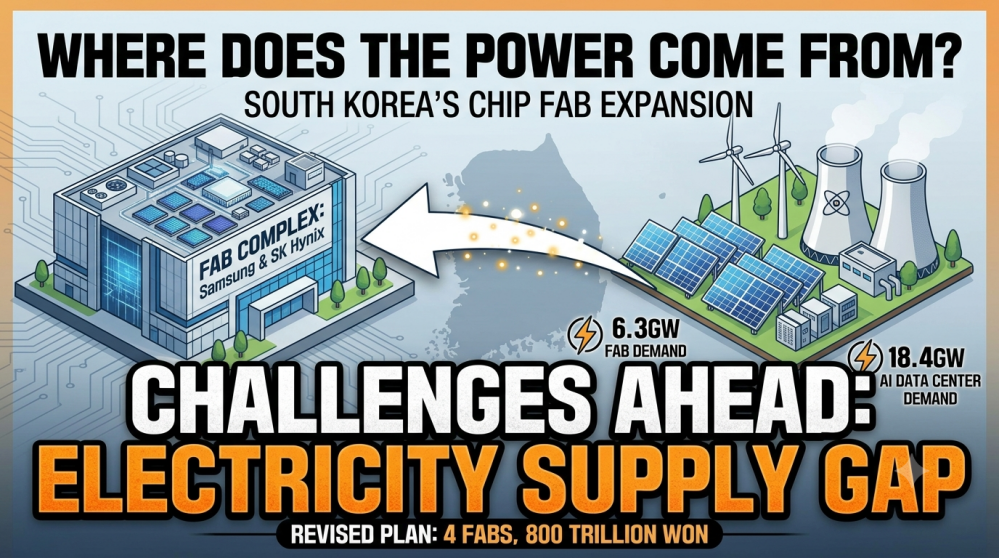
The original proposal called for six Samsung fabs and four SK Hynix fabs in Korea's southwest (Honam) region. The revised, more realistic version announced calls for four fabs total — two from Samsung, two from SK Hynix — backed by a combined 800 trillion Won budget. Combined power demand for the four fabs is projected at 6.3GW, and when paired with an associated 1GW AI data center, total demand reaches roughly 7.3GW.
Inside Korea's 24.7GW Power Gap: What It Means for Samsung, SK Hynix, and AI Data Centers 반응형Why Renewable Power Alone Can't Cover It
Honam is one of the few regions in Korea with a power surplus, currently running at 208% self-sufficiency. Solar capacity is already substantial and slated to expand to 5.4GW by 2030, while a 12.3GW offshore wind project is underway near Sinan. On paper, 7.3GW looks well within reach.
The catch is intermittency. Solar and wind output varies by time of day, season, cloud cover, and wind conditions — but semiconductor fabs and data centers require firm, uninterrupted power around the clock, including at night, in winter, on cloudy days, and when the wind isn't blowing. At this scale, the gap is far too large for battery storage systems to bridge, meaning LNG or nuclear backup generation is essential.
Hanbit Nuclear Plant: The Obvious Backup, With a Timing Problem
The most reliable backup option is nuclear power, and Honam has a natural candidate: the Hanbit nuclear plant, located just 45km from Gwangju with 5.9GW of capacity across six reactors (roughly 5GW in practice, accounting for maintenance), and close enough that transmission infrastructure shouldn't pose a major obstacle.
The problem is reactor lifespan. Hanbit's Unit 1 already went offline in December 2025 after reaching the end of its licensed operating life, and Unit 2 is scheduled to follow in September 2026, with Units 3 through 6 to follow on a staggered timeline. Unit 1's life-extension review is still underway and is expected to take roughly two years to complete — a delay caused in part by starting the extension review too close to the original shutdown date rather than well in advance. Even if approved, the extension would only run through December 2035, leaving roughly eight years of usable operation. Units 3 through 6 face a similar timeline risk unless extension reviews begin promptly. Notably, Hanbit has no expansion plans, meaning current capacity represents its practical ceiling — and any power redirected to backing up the new fabs would reduce what Hanbit currently sends to the greater Seoul metropolitan area.
If Hanbit is dedicated to backing up the Gwangju fabs, supplemented by LNG generation, the 7.3GW requirement appears tight but potentially manageable. A separate water supply requirement of 650,000 tons is also under discussion, though officials have noted this isn't a uniquely new problem — the previously planned Yongin fab site faced similar water constraints, with recycled wastewater floated as one potential solution.
The Bigger Challenge: 18.4GW of AI Data Centers
The fab power requirement may prove to be the easier problem. A separate plan calls for building 18.4GW of AI data center capacity nationally — 8.4GW by 2029 and a further 10GW by 2035. The first phase includes projects in Gangwon (2.4GW, GS), Sejong (1GW, SK), a Naver-linked 1GW project, Donghae (2GW, SK), Honam (1GW, SK), and Ulsan (1GW, SK).
Data centers are, in some ways, a harder power problem than fabs. Semiconductor manufacturing can flex utilization rates somewhat during power shortages, but AI data centers require constant, fixed power around the clock — a demand profile poorly matched to renewables and best served by nuclear, supplemented by LNG. Encouragingly, some first-phase sites appear deliberately located near existing nuclear or thermal plants: Donghae sits near the Hanul and Shin-Hanul nuclear plants, Ulsan near Kori and Saeul, and central-region sites near the Dangjin, Taean, and Boryeong coal plants. The second-phase 10GW, concentrated mostly around Sejong, currently lacks a clear power sourcing plan.
The National Power Supply Picture
Metric Figure Total national capacity (Dec 2025) 156GW Peak demand ~98GW Real usable surplus (accounting for renewable variability and maintenance) 10–18GW New firm demand: Yongin fab complex (under construction) 16GW New firm demand: Honam fabs 6.3GW New firm demand: AI data centers 18.4GW Total new firm demand ~40GW New firm capacity planned in 11th Basic Electricity Plan (2024–2038) ~6GW (Shin-Hanul 3&4, SMRs, 2 undetermined large reactors) The math is stark: the 11th Basic Electricity Plan's entire planned new firm capacity of roughly 6GW is barely sufficient to cover the already-under-construction Yongin complex alone, leaving the combined 24.7GW needed for the Gwangju fabs and AI data centers essentially unaddressed in current planning. For context, one modern large-scale reactor generates roughly 1.4GW, meaning 24.7GW is equivalent to about 18 new large reactors — a scale of buildout not currently reflected in Korea's power planning timeline.
Timeline and Execution Risk
The first-phase Honam fab is slated to break ground sometime between 2028 and 2030, with completion targeted for 2032–2035 — a wide window reflecting that the specific site hasn't been finalized. Gwangju's former airport site is considered a leading candidate, but since it currently serves a military function, relocation to a replacement facility would need to be completed before construction could begin. Because Samsung and SK Hynix's Yongin fabs are already under construction and take development priority, the Gwangju project is likely to proceed opportunistically as siting, water, and power issues get resolved — functioning more as a long-term addition to the roadmap than an immediate priority.
A separate mega-project — physical AI deployment in Korea's auto and shipbuilding industries — carries its own complications, primarily around labor. Physical AI adoption in these sectors could meaningfully reduce employment, making it a politically sensitive undertaking likely to face significant labor-management friction.
Bottom Line
The central question for Korea's semiconductor and AI data center expansion isn't financing — it's power. Combined new firm power demand from the Yongin fab complex, Honam fabs, and planned AI data centers totals roughly 40GW, while Korea's current 11th Basic Electricity Plan accounts for only about 6GW of new firm capacity through 2038. For Samsung and SK Hynix, the Gwangju project functions as a long-term addition to already-prioritized Yongin fab construction, with power, water, and siting questions likely to be resolved incrementally rather than immediately. The upcoming 12th Basic Electricity Plan, expected later this year, should offer a clearer picture of how the government intends to close this gap.
This article is for informational purposes only and does not constitute investment, tax, or legal advice. Readers should consult a licensed professional before making investment decisions.
반응형'Global Markets > Supply Chain & Geopolitics' 카테고리의 다른 글
Korean Stock & Equity Research
Data-driven analysis of Korean listed companies, combining financial fundamentals with supply chain and operations insights. Not investment advice.