-
Korean Equities/Company Deep Dives
Why Hanwha Ocean Lost Canada's $44 Billion Submarine Deal
2026. 9. 10.
Table
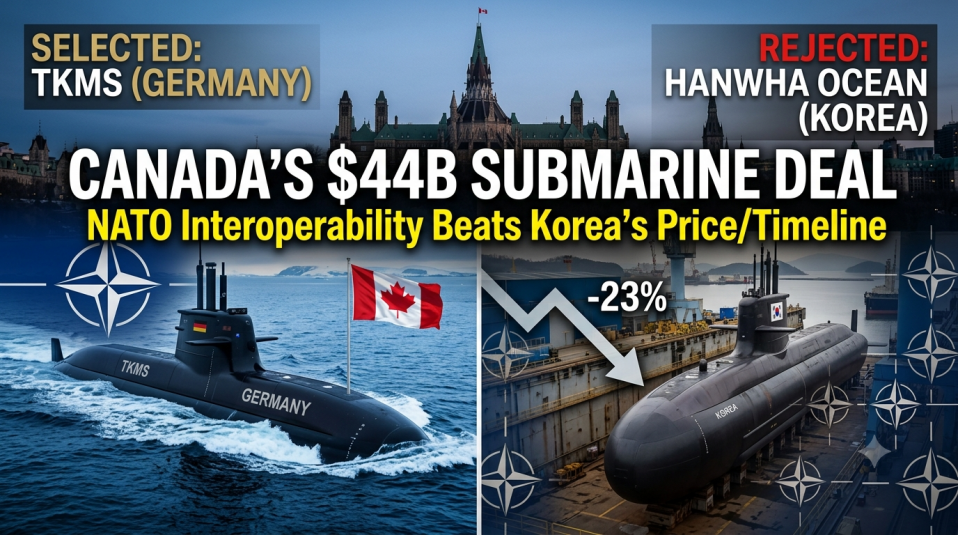
반응형Canada picked Germany's TKMS over South Korea's Hanwha Ocean on July 6, 2026 for its Canadian Patrol Submarine Project, a contract worth up to C$60 billion (about $44 billion), sending Hanwha Ocean shares sharply lower on the news. The stated reasoning wasn't primarily about price or delivery schedule — Prime Minister Mark Carney cited NATO interoperability and Arctic-optimized technology, pointing to a structural disadvantage Korean defense exporters face whenever they compete for contracts inside NATO's own supplier network. This analysis is part of Koreanalysis's coverage of Korean defense exporters and their exposure to Western alliance procurement politics.
반응형What Was the Canadian Patrol Submarine Project, and What Happened?
Canada has been trying to replace its aging Victoria-class submarine fleet with up to 12 new conventionally powered boats through the Canadian Patrol Submarine Project (CPSP), a program worth up to C$60 billion (roughly $44 billion) over its full life cycle — one of the largest defense procurement decisions in Canadian history. Hanwha Ocean and HD Hyundai represented Korea's bid, competing against Germany's TKMS (thyssenkrupp Marine Systems). On July 6, 2026, Canada announced TKMS as its preferred bidder, and Hanwha Ocean's stock reportedly fell as much as 23% on the news, per CNBC.
Dimension TKMS (Germany) — Selected Hanwha Ocean / HD Hyundai (Korea) — Rejected First 4 boats delivered by 2036 2035 (one year earlier) Full 12-boat fleet by Later than Korea's proposed timeline 2043 NATO supplier relationships Already supplies over 1/3 of NATO members None among NATO navies Joint-build arrangement Built with Norway; both nations cede a production slot to Canada, forming a combined 24-boat NATO fleet Standalone Korean build Why Did NATO Interoperability Outweigh Korea's Faster Timeline?
Korea's bid was reportedly faster on paper — delivering the first four boats a year earlier than Germany's proposal. But Prime Minister Carney's public explanation leaned on different criteria entirely: TKMS's Type 212CD platform uses fuel-cell air-independent propulsion enabling more than 40 days of near-silent submerged operation, is "optimized for Arctic waters," and is "fully NATO interoperable" — a submarine design already fielded or ordered by more than a third of NATO's member navies. Carney called both proposals strong but framed the decision around Canada's "strategic, security and economic interests" as a whole, not a narrow technical or price comparison.
Hanwha Ocean's own statement described running into "the wall of the NATO alliance" — company language, not Canada's official framing, but a telling admission that Korea's technical competitiveness (Hanwha reportedly sailed a submarine across the Pacific as part of its bid effort) couldn't fully offset the advantage of joining an existing NATO-interoperable supply and maintenance network shared with allied navies.
⚠️ Don't read this as Korea being "locked out" of NATO markets, or as a Trump-trade-war story
Two things worth qualifying. First, Canada's decision was announced July 6, 2026 — well before the separate US-Canada tariff war escalated into retaliatory tariffs on September 8. The submarine decision and the trade war are two distinct storylines that happen to both involve Canada's shifting alignment calculus; one didn't cause the other. Second, Hanwha Ocean remained the next-ranked bidder as of the announcement, meaning it could still re-enter the process if Canada's contract negotiations with TKMS stall — this wasn't necessarily a final, irreversible outcome the moment it was announced.
✅ What to watch from here
- Whether Canada's contract talks with TKMS proceed smoothly — if they stall, Hanwha Ocean's next-ranked status could still matter.
- Whether this loss changes how Korea structures future NATO-adjacent defense bids — joint ventures or technology-sharing arrangements with an existing NATO supplier could become a more common strategy than standalone Korean bids.
- Hanwha Ocean's stock recovery pattern in the weeks after the announcement, as a signal of how much the market treated this as company-specific risk versus a broader re-rating of Korea's defense-export growth story.
Korea's faster delivery timeline wasn't enough to beat an incumbent NATO supplier network — a reminder that defense procurement inside alliance structures often weighs interoperability and existing relationships as heavily as price or schedule.
What Should Investors Watch Next?
This loss lands against the backdrop of a Canada that has been recalibrating its international relationships more broadly this year — including a sharply deteriorating trade relationship with the United States, where Washington has separately been working to reduce its reliance on Canadian heavy crude as part of a wider realignment of North American energy and trade flows. Whether Canada's broader push toward NATO- and Europe-aligned partnerships extends into other procurement categories — and what that implies for Korean shipbuilders' and defense contractors' access to Western allied markets going forward — is worth continued attention as Korea's defense-export ambitions run up against alliance politics that price and delivery schedules alone can't overcome.
Frequently Asked Questions
Q1. Is Hanwha Ocean completely out of the running for Canada's submarine contract?
A. Not necessarily. Hanwha Ocean was named the next-ranked bidder when Canada selected TKMS as its preferred choice, which typically means it could re-enter the process if Canada's negotiations with TKMS run into problems — though there's no indication that outcome is likely or imminent.
Q2. Why did NATO interoperability matter so much if Korea's technology was competitive?
A. Submarine fleets require decades of shared maintenance, parts, training, and operational coordination. A platform already used by other NATO navies (TKMS supplies more than a third of NATO members) lets Canada plug into existing alliance infrastructure rather than building a standalone support ecosystem — a structural advantage that a faster delivery timeline alone doesn't offset.
Q3. Is this connected to the US-Canada trade war that escalated in September 2026?
A. Not directly — Canada's submarine decision was announced July 6, 2026, roughly two months before Canada's retaliatory tariffs against the US took effect on September 8. They're separate developments, though both reflect a Canada increasingly recalibrating which international partners it aligns with across trade and defense simultaneously.
Korea's faster delivery timeline wasn't enough to beat an incumbent NATO supplier network — a reminder that defense procurement inside alliance structures often weighs interoperability and existing relationships as heavily as price or schedule.
반응형'Korean Equities > Company Deep Dives' 카테고리의 다른 글
Korean Stock & Equity Research
Data-driven analysis of Korean listed companies, combining financial fundamentals with supply chain and operations insights. Not investment advice.